South Africa: From ashes to action

Cinderella Park is an informal settlement shaped by poverty, unemployment and inadequate housing. Many households live in makeshift structures and rely on unsafe energy sources, such as candles, for lighting. Limited access to electricity, water and formal infrastructure increases the risk of fires and other hazards, placing already vulnerable families at constant risk.
Women and children carry the heaviest burden in this context. Many households are supported by women or elderly caregivers with limited income and few safety nets. For the Dlamini family, this vulnerability was part of daily life. They lived in a small wooden structure and were already struggling to meet basic needs. The household is led by an elderly and ill great‑grandmother, the family matriarch, who cares for multiple generations under precarious conditions.
Before the intervention, Cinderella Park also faced limited access to practical skills development and economic opportunities, particularly for young women. Local women‑led organisations such as Women of Action were active and committed to community support, yet lacked the resources and opportunities to translate their work into visible, income‑generating or skills‑building outcomes. Community leadership existed, but it remained under‑resourced and under‑recognised.
It was within this context that tragedy struck. A fire damaged part of the Dlamini family’s home, leaving them without a safe living space and with no means to rebuild. The loss deepened their vulnerability and reflected the broader risks faced by many households in the settlement. The moment demanded a response that could address immediate humanitarian need while also strengthening long‑term resilience.
What followed was a practical, community‑led intervention that turned crisis into opportunity.
Through collaboration between Panorama Primary School, Sasopsbiz Foundation and Women of Action, the damaged home was rebuilt. Rather than approaching the rebuild as a once‑off act of charity, the process was designed to create shared value. Young women from Cinderella Park, particularly members of Women of Action, were trained on site in basic construction skills while rebuilding the Dlamini home.
The rebuilding process became a live learning space. Materials were sourced locally, and the worksite was used to transfer practical skills in a real‑world setting. As the house took shape, so did confidence, competence and a renewed sense of purpose among the women involved.
For the Dlamini family, the impact was immediate and profound. The rebuilt home allowed them to return to a safe and dignified living space after the fire. Stability was restored to a fragile, multi‑generational household, reducing immediate risk and affirming their dignity after loss.
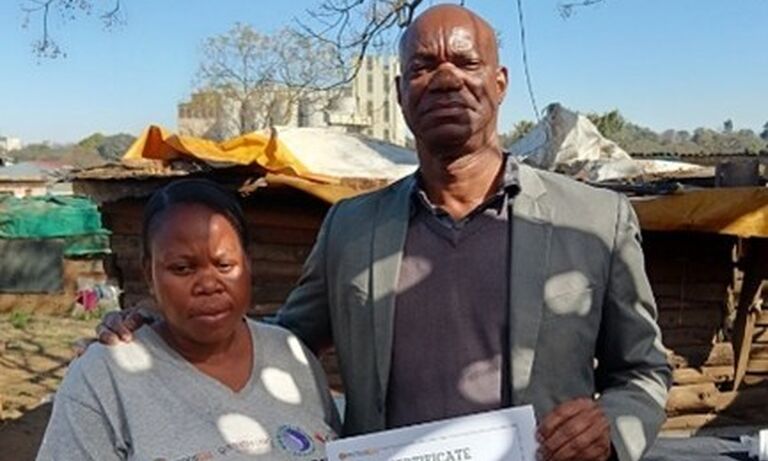
For the young women who participated, the change extended beyond the construction site. They gained hands‑on skills, received certificates recognising their training, and experienced a shift in how they saw themselves and their potential. As a direct outcome of the process, at least one woman secured formal employment. Another was identified and employed by a local warehouse during the procurement of materials. What began as community service opened pathways to income and opportunity.
Women of Action also experienced a turning point. After years of working in the community with limited recognition, the organisation emerged with tangible results that demonstrated its leadership and impact. The rebuilt home stood as visible proof of what local women‑led organising could achieve. This strengthened the organisation’s credibility and standing within Cinderella Park.
The wider community shared in the change. Neighbours came together to contribute time, food and decorations. The certificate handover, held at the rebuilt home, became a moment of collective pride and healing. The presence of the principal and deputy principal of Panorama Primary School reinforced the value of partnership and local solidarity. What could have remained a story of loss became a symbol of cooperation and shared ownership.
As Mrs Gabela, Principal of Panorama Primary School, reflected:
“What started as support to rebuild a room became something much bigger. This collaboration showed how a school, community organisations, and local women can come together to restore dignity and rebuild a community, not just a structure.”
Ugogo Dlamini, the family matriarch, described the emotional impact:
“We went through a lot of pain and loss after the fire. I did not know how we would stand again. The help we received brought our family back into the house and gave us hope. Seeing the young women build with their own hands showed us that life can change, even after great sorrow.”
For Nkosingiphile, one of the young women involved, the experience shifted how she viewed herself and her role in the community:
“I came to learn, but I also learned to give back. These skills helped me believe in myself, and rebuilding that home showed me that what I learn can change someone’s life, including my own.”
The evidence of change is visible and lived. A rebuilt home stands where loss once defined the space. Certificates confirm skills gained. Employment opportunities emerged directly from participation. Community behaviour shifted toward cooperation and shared pride. Women of Action strengthened its role as a trusted local anchor.
Sustainability lies in embedding this approach into ongoing community‑led practice. Women of Action will continue to mobilise residents, identify households in need and coordinate skills‑based responses to local challenges. The skills transferred to young women can be used for future employment, income generation and community service, reducing dependence on external support over time.
Scaling will take place through the Umgungundlovu Community Empowerment Network Initiative (UCENI), allowing learning from Cinderella Park to be shared and adapted in other communities. By grounding change in local leadership, practical skills and strong partnerships, this model demonstrates how rebuilding a house can also rebuild dignity, confidence and collective hope. From ashes, action emerged. And from action, a community rediscovered its strength.
Comments
Related Stories Of Change