Entry 13170
The project was designed to offer a holistic package to children and youth as opposed to offering interventions in silos. Thus in responding to SRH and HIV issues the project designed the project into inter depended thematic areas and these were; education, health and nutrition, Household Economic Strengthening, Psycho-social support and care, Gender Based Violence, Child Protection. The project recognised that girls and boys have multifaceted challenges and needs which cannot be addressed by offering a single service in silo.The aim of this project is to enhance the capacity of communities and local service providers to sustainably care for vulnerable children and families and to strengthen the capacity of vulnerable households to sustainably care for children. It also opts to strengthen the capacity of the social services system to care for vulnerable children.
The project has reached 86% participants through direct beneficiaries. The government has not allocated any funds to support this project. However, in kind contributions amounted to $2000. Hence, the total for this project is only $2000.
The main challenge has been on some of the Sexual Reproductive Health and Child Rights Education material being not age specific and some instances being not cultural specific to the local context. This was addressed by simplifying the material to younger children through drama, song and poetry as opposed to have go through the material in its original form. Another challenge pertains to insufficient resources to motivate the community based cadres who directly work with the Orphans and Vulnerable Children (OVC) and their families.
This impeded the timely delivery of services as some of the caregivers were not mobile to reach clients under their jurisdiction on time. Effort was made to train more community cadres so as to minimise the distances they travel. In addition, linkages and networking with other volunteers in communities augmented the project community cadres' effort.
Methods used were largely qualitative through Most Significant Change stories and testimonials of the beneficiaries. In addition, a baseline survey was done to benchmark the project outcomes against the current circumstances.
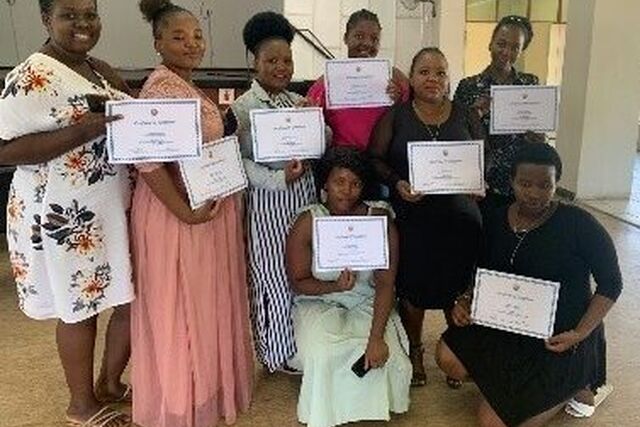
Women were trained in Internal Savings and Lending’s Scheme (ISAL). The started their own Income Generating Activities (IGA). In turn the savings are being used to meet basic needs of children such as school fees, health and food.
Tsungirirai says, “When I joined ISAL I could hardly meet my monthly obligation and I had failed to pay school fees but now I am managing to pay fees for my child." Men's involvement is still low however at least the project have managed to increase their participation in programmes from about 5% to about 15% by the third year of implementation.
Recent survey has shown increased livestock, poultry and increase on income base of the women and men participating in the project. Attitude has changed since the project inception there were few men participating in SRH and ISAL activities since they labelled these activities as females’ activities but as of now about 15% of them are now participating.
For a project to be successful it has to ride on partnership and that Household Economic Strengthening (HES) need start-up capital for them to be effective. These can be harnessed through developing a project that is broader and involve start-up capital for beneficiaries participating in HES activities.
Comments
Related Stories Of Change