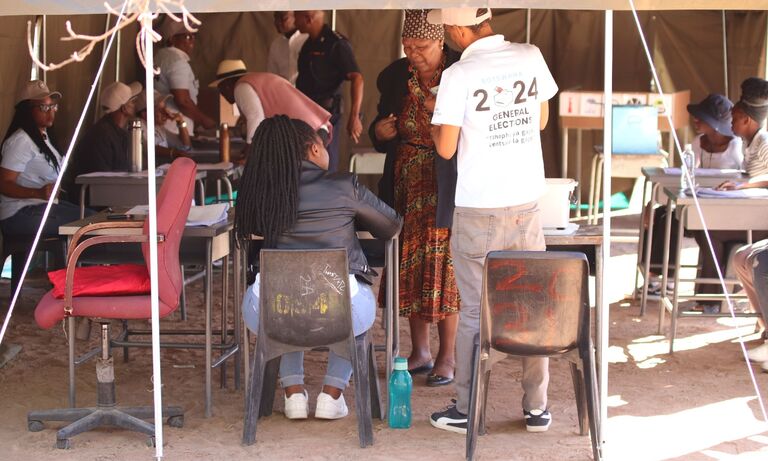
Gaborone - October 30, 2024: As Botswana goes to the polls today, preliminary results from Gender Links (GL) Media Monitoring show that women constitute less than three percent of news sources in the political topic category. GL, in partnership with the International IDEA Women Political Participation (WPP) in Africa project, has, from October 1, 2024, been conducting Media Monitoring for the election period.
The monitoring, which will run until 15 November, is the only comprehensive media monitoring of the elections currently underway. On the eve of the elections, men constituted 97.2% percent of news sources on elections with women a mere 2.8% of news, features, interviews, analysis and commentary. “In over twenty years of gender and media monitoring across Southern Africa this is the worst outcome we have ever seen,” noted GL Special Advisor Colleen Lowe Morna. “We know that generally (and sadly) women sources tend to dip during elections that are heavily male dominated.
But to dip below ten percent after all the advocacy on women’s political participation is truly disappointing.” In the last major Gender and Media Progress (GMPS) study carried by GL out in 2020, women constituted 21% of news sources in Southern African media coverage, and 26% in Botswana. As an illustration of how women sources drop during elections, South Africa, with 29% women sources in the 2020 GMPS, recorded just 13% women sources in the May 2024 elections in that country. “It is a stark reminder of just how far we still have to go in achieving gender equality that the media, which should give ‘voice to the voiceless’, silences women during elections, the most important of all democratic projects,” noted GL Women’s Political Participation manager Mabetha Manteboheleng.
The elections monitoring underway in Botswana covers all mainstream media – Daily News, Mmegi, The Monitor, The Guardian, Midweek Sun, The Gazette, The Voice, Weekend Post, Sunday Standard, The Patriot on Sunday, Btv, YTV, GabzFM, DumaFM, YaronaFM, Radio Botswana and RB2. In addition to all digital platforms of the mainstream media, the monitoring also focused on two online publications, The Argus and The Parrot. The monitoring runs from 1 October to 15 November (pre, during and post elections). The pre-election period was dedicated to party manifestos and candidate launches, as well as issue-based debates, news and news briefs were high up, with the genre making 85.5% of the election reporting focus. Although still low, women’s voices came through inside pages, features and analysis (17%), and interviews, profiles and human interest stories scoring eight percent.
The ruling Botswana Democratic Party (BDP) received most coverage (61%) with the main opposition, the Umbrella for Democratic Change (UDC) coming second at 21%, and the Botswana Congress Party (BCP) and Botswana Patriotic Front (BPF) receiving eight and seven percent respectively. Botswana Republican Party (BRP) got two percent with Botswana Movement for Democracy (MBD) and independent candidates getting one percent each. During this period, parliamentary and presidential candidates, constituted the majority of the sources (39% and 23% respectively). Given the very low proportion of women candidates in the elections (see breakdown here) these sources are almost all men. Civil society and experts constitute one percent each, and council candidates, two percent each of sources.
Party spokespersons, contribute substantially to political news sources. Again, these are almost all men. Although negligible, radio recorded the highest number of women sources, at eight (8%), with newspapers and television coverage at three and two percent respectively. Also of interest from the preliminary results was the age group of the sources. Despite constituting 60% of the population, youth below the age of 35 barely feature as news sources. The preliminary results show that women journalists constitute 41% of these reporting on politics in Botswana. Stories by women reporters showed only a slightly higher proportion of women sources (4%) compared to men (1%). The proportion of news reported by women varied by media house from 100% in Argus Online and Yarona, with Botswana TV (BTV) at 68%. Other media houses with a strong representation of female reporters covering elections (over 50%) were The Midweek Sun, YTV, GabzFM, and Daily News.
The Gazette and Parrot Online, had only male reporters. In terms of media ownership, state media is well ahead of private media with 62% to 32% in female representation. The period monitored so far showed a heavy focus on election campaigns, neglecting issues affecting women, such as gender equality and violence against women in politics. Gender as a topic featured in less than one percent of the 470 stories monitored. Gender equality was referred to in only 6.5% of content. One positive is that the monitoring so far has revealed limited use of sexist and blatant stereotypes, as is sometimes the case in election coverage. However, monitors classify most stories (69.2%) as gender blind (ie women’s views are missing) with some subtle stereotype at 16.2%.
The Media Monitoring continues to mid-November to cater for issues arising from the elections. GL will issue a Gender Audit of the Botswana Elections featuring the media monitoring and several other components on 25 November, International Women’s Day and the start of the Sixteen Days of Activism that stretches to 10 December, Human Rights Day. (The Botswana Gender and Media Monitoring results can be viewed in real time on this link. For more information, contact GL Botswana Gender and Elections Audit Manager Pamela Dube on +267-77132086)
Comments
Related news