Zimbabwe: No looking back, a journey of determination

Editor Mavumbu's journey of determination and entrepreneurial rise
Background: Life Before the Intervention
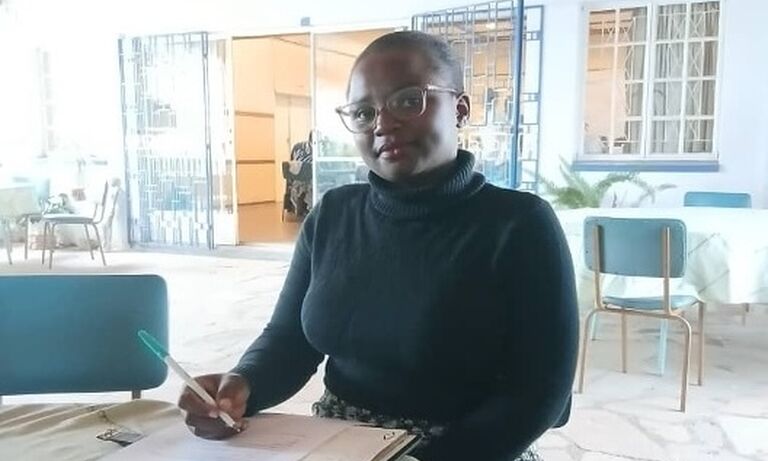
Editor Mavumbu is a 33-year-old female entrepreneur based in Mutare. She is married and a mother of two young boys with a third child expected soon. She is the current Chairperson of Eastern Mushroom Co-operative; an enterprise created under the Gender Links Zimbabwe’s Gender Inclusive Local Economic Development (LED) Project working with Mutare City Council. Editor is a trained refrigeration expert but due to limited employment opportunities, she found herself doing broiler management to survive. Broiler-management was a self-taught venture as she searched on the internet on how to go about it. She has a strong passion for gardening, and this was her breakthrough into the LED project. She was spotted by a Council employee living in the same neighbourhood called Raheen in Mutare, when they observed her interest and invited her to join the Co-operative.
Before participating in the LED project, Editor says “I had always wanted to run my business professionally, but I did not know how to go about it.” In her poultry business and the few jobs, she did in refrigeration, Editor admits that “I had poor record-keeping, I lacked financial literacy and as such I mismanaged the revenues I generated.” She said she could not tell whether she was growing or not in her ventures. This led to a lot of mistrust and conflict over finances with her husband given that the broiler management venture was a co-owned family business.
The Intervention: access to skills, networks and opportunity
Once she joined the Eastern Mushroom Co-operative, Editor proved her worth. She led from the front, helping other members to apply their taught knowledge on primary mushroom production. It is not surprising that she was elected the Chairperson of the Co-operative in 2024 despite her reserved nature and being among the youngest members of the Co-operative.
As a group, they first received life-skills training before embarking on entrepreneurship development – covering topics such as record-keeping, financial management and marketing among others. After her training, she is not shy to market her produce “…even if it means I have to sell door to door,” Editor confidently shared.
Editor is grateful to other organisations that have delivered training in collaboration with the Council. She has benefitted from the ZimTrade’s She Exporter training; Standards Association of Zimbabwe’s delivery on quality and standards; as well as Ministry of Women Affairs, Community, Small and Medium Enterprises Development (MWACS) training in conflict management and their support in company registrations.
The most significant change
For Editor, the most significant change has been the transformation of her confidence, visibility and leadership beyond the mushroom enterprise. In 2025, she attended the African Women in Dialogue (AfWID) annual meeting, a platform that brings women across Africa to call with one voice on matters of development, gender equality, leadership among other issues affecting women. Editor was part of the delegation from Gender Links Zimbabwe. Being selected as part of the Zimbabwe delegation was both an honour and a validation of her growth as a leader under the Gender Inclusive LED Project. The exposure broadened her worldview. For the first time, she interacted with women entrepreneurs and leaders from across Africa, exchanged ideas, and gained insight into scaling enterprises beyond local markets. She returned home more confident, more strategic and more ambitious about her business. She believes that this regional exposure earned her respect from her peers, family and community. ‘Kungokwira ndege zvinekakuremekedza kwazvinounza so,” (Getting on a plane comes with some certain level of respect) she says with a small laugh.
Business change – “there are quick returns in the mushroom business. I was able to save enough money from the business to finish-off my new home.” Editor makes an average of US$800 profit from her mushroom business even at a small scale where she invests US$250 capital in the business. She had a brief set-back when she moved to her current new home and used up her business funds to finish off her home. She also could not immediately resume her mushroom business because the area she moved in has termites and required a brick and motor structure as opposed to wooden structures. With determination, she has put up a basic structure and has had two months of harvest realising US$420 to date. ‘Once I invest in an air conditioner to regulate temperatures, I should be able to double my produce and income,” said Editor.
The City of Mutare has profiled her in their social media, and this has even brought in unexpected results. “I now get enquiries and contracts for my refrigeration repair services through the Council profiles.”
Her profile by the City Council generated new enquiries and contracts for her refrigeration repair services thus, increasing her market opportunities. This diversification of income streams strengthens her financial stability and positions her as a multi-skilled entrepreneur. She views this change beyond just economic, but rather personal, social and transformational. She is no longer just participating in development programmes; she is influencing others.
Other than being Chairperson of a 36-member Co-operative, the LED project has exposed her leadership qualities. At church, Editor transitioned from being an ordinary congregant to serving within the finance department leadership. She is now invited to share her entrepreneurship journey with different church groups, positioning her as a mentor and an inspiration to others.
Perhaps the most transformative change for Editor is within her household. With improved financial literacy and cashflow management skills gained through the LED project, she now keeps proper records and plans expenditures. This transparency has restored trust with her husband, reduced financial conflict and strengthened spousal support for her business ventures. “My husband now trusts me because of the training I received and there is reduced conflict over money at my house.”
Challenges remaining
Despite her progress, Editor still faces some notable challenges. She has limited capital to invest in climate control equipment necessary for optimal mushroom production. She also has limited resources to establish ideal infrastructure in her new location. She needs to balance scaling production and household responsibilities, especially with a third child expected soon.
Future vision
Editor’s desire is to strengthen the Eastern Mushroom Co-operative into a sustainable, market-oriented enterprise during her tenure. At a personal level, she wants to be able to mentor other young women interested in agribusiness. As a family, they have acquired a 1.5-hectare plot in Fern Valley, Mutare. She has big dreams to drill a borehole, establish greenhouses and produce high value horticultural crops such as bell peppers. She has plans to expand beyond oyster mushroom production to the high value white button mushroom. Access to affordable financing and advanced business development support would significantly accelerate her growth plans.
Her long-term dream is to become a leading female agripreneur in the region — demonstrating that with the right skills, networks and opportunity, rural and urban women alike can build profitable, sustainable businesses.
Comments
Related Stories Of Change