
Madagascar: Une leader régionale transforme la survie en autonomie économique pour les victimes de VBG

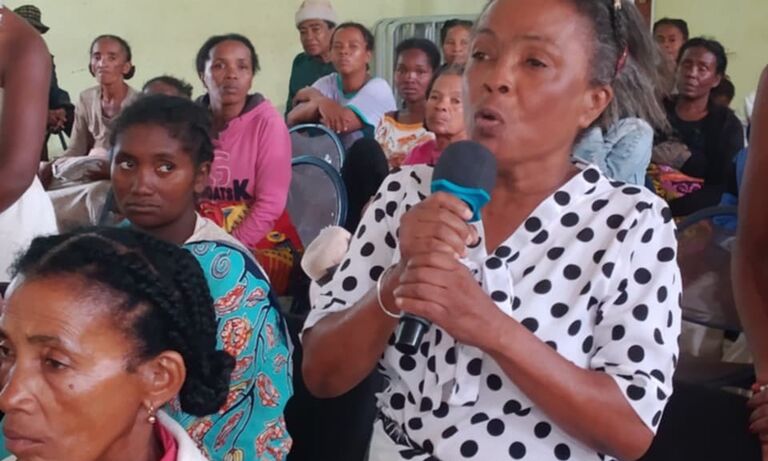
A regional woman leader in Anôsy, Madagascar is transforming gender‑based violence response by linking justice, psychosocial support and economic empowerment, enabling 132 survivors to rebuild independence and dignity.
Norline RAZAFITSARANDRO is the Regional President of the Federation for the Promotion of Women and Children (FPFE) in Anôsy, Madagascar, elected three times since 2018. Her leadership is grounded in proximity, resilience and the belief that women and girls must have the means to rebuild their lives after experiencing violence. She coordinates economic resilience projects and income‑generating activities supported by Gender Links, FANAINGA and FANAINGA PLUS (GIZ).
Her work focuses on combating gender‑based violence through a holistic model that combines legal protection, psychosocial support and pathways to economic autonomy. In partnership with the Ministry of Population and UNFPA, she plays a central role in managing the Centre d’Écoute et de Conseil Juridique (CECJ), which provides survivors with a safe entry point toward recovery and independence. Through strategic mobilisation of funding and entrepreneurial training, 132 women survivors have gained sustainable income and renewed socio‑economic stability
The change began by integrating justice and economic empowerment. Norline strengthened institutional coordination to professionalise the CECJ, ensuring safe spaces for women, children and men affected by violence. Legal support, psychosocial care and community‑based assistance were expanded, rebuilding trust between survivors and public institutions.
She mobilised strategic financing to support survivor entrepreneurship. With Gender Links support, 50 women received entrepreneurial training and funding to launch income‑generating activities. Through the FANAINGA programmes, further 82 beneficiaries developed skills and began new economic ventures. Every survivor now follows a structured pathway: intake at the CECJ, legal guidance, professional training, financial education and access to start‑up funding.
This integrated model has strengthened service delivery and institutional mechanisms. At regional and local levels, protection systems are more responsive and survivor‑center. The key beneficiaries are survivors of violence, their families, and communities. The 132 women now earning income are less vulnerable to re‑victimisation and are more confident in decision‑making.
Sustainability and expansion rely on multisectoral collaboration involving ministries of Population, Justice, Public Security, Health, Education and Vocational Training. Capacity‑building of local actors ensures continuity of services and documentation of results across districts. Ongoing support from Gender Links, FANAINGA, and GIZ will help integrate the model into local development plans.
Economic independence itself is a driver of long‑term change. As survivors gain autonomy, they inspire others and contribute to a more inclusive, resilient and gender‑equal society
Quotes
Georgia, Le centre m’a écoutée quand j’étais au plus bas, mais Mme Norline m’a donné les outils pour me relever.
Deline, Grâce à l’appui financier et à la formation, j’ai pu lancer mon activité de vannerie et briser le cycle de la violence.
Comments
Related Drivers Of Change