South Africa:I Am More Than My Disability

“Thank you that we can actually have this conversation; no one ever raises this conversation from a person with disability perspective.”
These words from Ingrid Bame, a passionate advocate for disability rights, capture the essence of her journey—a journey of breaking barriers, challenging stereotypes, and empowering women with disabilities to speak out against gender-based violence (GBV).
Empowered Through Knowledge
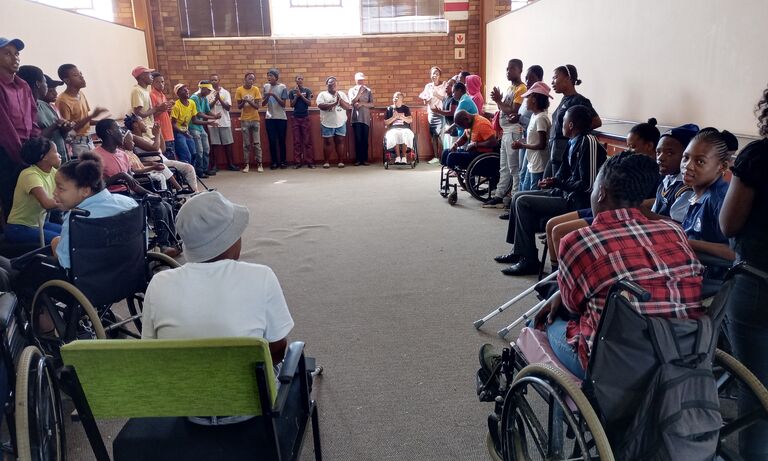
Ingrid is one of the women who received Disability GBV Training under the Enabled Women Arise (EWA) project, implemented by NCPD and supported by Gender Links through the WVL-SA programme. The training equips women with disabilities to educate others about GBV from a disability perspective, creating ripple effects of awareness and empowerment.
For Ingrid, the experience was transformative. “Is your disability imprisoning you? Are you limiting yourself to things you can and cannot do because of the disability you have?” she asks during her sessions. These questions stem from her own realization that self-imposed limitations can be as restrictive as societal barriers. Today, she uses these conversations to challenge women with disabilities to reclaim their agency.
Beyond Barriers: Advocacy in Action
Before joining EWA, Ingrid was already active in the disability space. She is a strong advocate for persons with albinism and runs an online platform called I am movement, which spreads positivity and counters harmful narratives. Her work addresses issues such as the killings of persons with albinism and the lack of positive representation in mainstream media. Through her platform, Ingrid emphasizes: “I am more than my albinism.”
Her advocacy extends to radio, where she hosts Personified on Impulse Radio—a show dedicated to conversations around disability. Ingrid is also a motivational speaker and a radio enthusiast, using media to amplify voices that are often silenced.
Confronting Hard Truths
The EWA programme deepened Ingrid’s understanding of the complex interplay between disability and GBV. “Do you realize that you are putting yourself in a situation where you can’t live a fully-fledged life like what the world considers ‘normal’ because of your disability?” she asks her group members. These candid conversations are not easy, but they are necessary. They help women recognize both external and internal barriers to living empowered lives.
Ingrid conducts educational sessions for women with albinism and other disabilities, creating safe spaces for dialogue. The feedback has been overwhelming: “Thank you that we can actually have this conversation; no one ever raises this conversation from a persons with disability perspective.” These remarks underscore the importance of addressing GBV through an inclusive lens.
Expanding Impact Through Digital Platforms
Ingrid is determined to take these conversations beyond physical spaces. She plans to package recordings of her sessions into podcasts to reach broader audiences. “We intend to take the recordings of the sessions and see how we can package them into content for a podcast, reaching communities beyond those in the room. Hopefully, this will have an impact on how GBV is understood in relation to disability.”
Challenges and Aspirations
Despite her successes, Ingrid acknowledges the challenges. “Women with disabilities are few and far apart, and bringing them together is difficult. The subject matter is daunting—it takes a lot of convincing and one-on-one engagement.” Yet, she remains committed. With more support, Ingrid hopes to run smaller, long-term series to track changes over time and deepen impact.
Her story is a testament to resilience and innovation. By leveraging media, technology, and grassroots engagement, Ingrid is redefining advocacy for women with disabilities in South Africa.
By: Ingrid Bame.
Comments
Related Drivers Of Change