Southern Africa: Alliance resolves to push forward

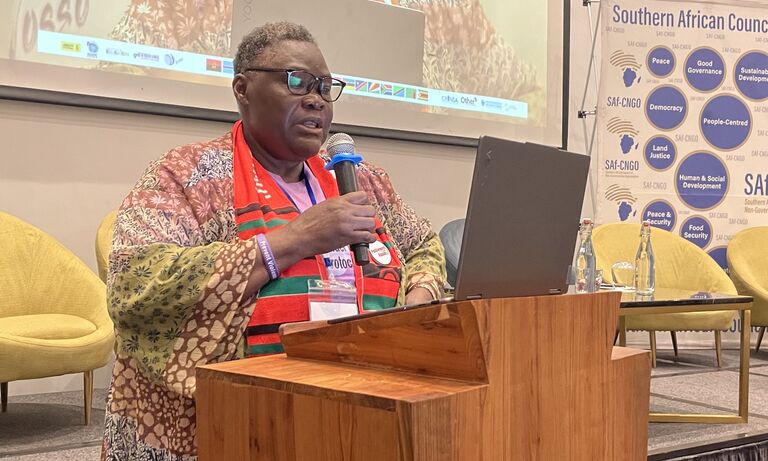
Antananarivo, 21 August: Women’s rights organisations emerged from the annual convening of the Southern African Council of NGOs (SAfCNGO) determined to #PushForward4GenderEquality.In a statement issued after the weeklong convening in the Madagascar capital, leaders of the Southern African Gender Protocol Alliance said the “SADC we want is one on which women and girls in all their diversity realise their full rights as citizens, without fear of harm, stigma or persecution.”A review of progress against targets on Gender Day (20 August) showed that thirty years after the Fourth World Conference on Women in Beijing, and with five years until the deadline of the Sustainable Development Goals (SDGs), the ideals of gender equality lag.The Forum took place in the shadow of rising global and regional backlash and anti-gender rights movements that threaten the fragile gains made since the adoption of the SADC Protocol on Gender and Development in 2008. The Alliance is a “network of networks” that came together in 2005 (the tenth anniversary of the Beijing conference) to campaign for the only sub-regional instrument in the world that brings together all global and continental commitments to gender equality and enhances these through an action-and-results framework.Despite the lofty commitments, women in Southern Africa remain most of the poor, the dispossessed, the landless, the jobless, those missing from decision-making, those living with HIV and AIDS and high levels of gender violence. Contradictions between customary and statutory law result in legal gains being effectively undermined.Several other forms of exclusion intersect with gender to compound the misogyny associated with patriarchal norms. These include (but are not limited to) race, class, ethnicity, the rural/urban divide, age, disability, occupation (especially sex work), sexual orientation and gender identity. Women with disabilities, indigenous women and LGBTI persons experience multiple and intersecting layers of discrimination, violence, stigma and exclusion.The Alliance, which represents the gender sector in SAFCNGO, calls on SADC member states to:
- Enshrine gender quality, bodily integrity, voice and choice in all their Constitutions, and to ensure that these Constitutions take precedence over customary law.
- Domesticate Model Laws on Ending Child Marriages, GBV and Femicide and develop a model law on safe abortion.
- End gender-based violence (GBV) and harmful practices through advocating for more stringent penalties, educating leaders, engaging men as allies, securing funding, implementing the SADC GBV model law, training religious and traditional leaders, media engagement, and supporting re-entry to school for affected girls.
- Repeal outdated colonial laws that deny citizens their human rights through, among others criminalising homosexuality, abortion and sex work.
- Harmonise national laws with international and regional commitments, ensuring consistency between domestic frameworks and instruments such as the Maputo Protocol.
- Recognise LGBTIQ+ rights as human rights in SADC frameworks and ensure meaningful participation of LGBTIQ+ activists in decision-making processes; launch a Gender Inclusivity Barometer to measure how inclusive SADC and civil society spaces are in policy, funding, and participation.
- Mainstream comprehensive, age-appropriate, and gender-sensitive sexuality education into national school curricula, with adequate teacher training and monitoring. Strengthen rural outreach by ensuring that SRHR services, including maternal health, contraception, and safe abortion where legal, are accessible and affordable in remote areas.
- Recognise women's care work, remove taxes on sanitary products, promote equal education and economic opportunities with intersectional approaches, adopt and address social and cultural barriers to women's land ownership.
- Ensure the equal participation of women and girls in all their diversity Science Technology Engineering and Mathematics (STEM).
- Increase women’s participation in climate decision-making, build a pool of women negotiators, and advocate for SADC Countries to adopt Gender National Actions in line with the Lima work programme on Gender.
- Include women in just energy transition discourse, build capacity of women’s rights organisations on energy issues, support gender-responsive investments, and enhance community capacity on smart agro-ecology with cross-learning exchanges.
- Conduct research and develop action plans on the intersections of between climate change, women’s unwaged work and GBV.
- Mandate gender-responsive ICT policies, establish regional monitoring for press freedom and online safety, invest in affordable broadband and energy access, support gender-focused subsidies, and protect journalists’ safety, especially women and LGBTIQ+ media workers.
- Enforce quotas calling for 50% women in all areas of decision-making, while creating an enabling and safe environment for women politicians through mentorship, networking, sensitisation, addressing Violence Against Women in Politics and supporting women in office.
- Revitalise the Alliance as it celebrates its 20th anniversary to be more diverse, inclusive and fit for purpose in the run up to 2030.
- Take up the commitment of Hon Aurélie RAZAFINJATO, Minister of Population and Solidarity in Madagascar, now chair of the Gender Sector, to an “open door” policy by requesting a revival of the practise of WRO being included in ministerial meetings that inform the SADC Heads of State Summit.
- Propose an updating of the SADC Gender Protocol ahead of 2030, to take account of the many new developments since the last update in 2016.
- Take up the invitation by the President of the National Assembly of Madagascar, Justin Tokelay, also the Chair of the SADC Parliamentary Forum, to make a submission to the Executive Committee in November, in preparation for the next session of the Forum in June 2025.
- Establish the Tana25 Gender Climate Working Group to drive the information dissemination, capacity building on this vital subject.
Comments
Related news