G20: Leading with equality, solidarity, sustainability

In a time of escalating conflict, rising nationalism, and increasing assaults on women’s and LGBTQI rights, it is absolutely essential to seize every opportunity to drive a bold, progressive agenda that prioritises people and planet over profit and self-interest. The G20 is one such moment.
The G20 Leaders’ Summit takes place this weekend in Johannesburg. South Africa is the only African country in the group and, significantly, this is the first time the G20 is convening on the African continent. The Summit marks the culmination of a year of activities and hundreds of multilateral meetings. Leaders from 19 countries and two regional blocs — the European Union and the African Union — will come together to discuss international economic cooperation and policy coordination to advance global financial stability and growth.
It’s a big moment, not just because Johannesburg will host global leaders, but because Africa itself is rising. The African Union (AU) achieved full, permanent membership in the G20 in 2023, significantly increasing Africa’s representation in global economic decision-making.
South Africa has used this opportunity to centre African issues in this year’s G20 priorities and showcase our leadership on the global stage in addressing pressing economic, social and political issues. Under the themes of Equality, Solidarity and Sustainability, South Africa has driven a progressive agenda that aims to promote fair and inclusive development, ensuring that all individuals—regardless of background or circumstance—have equal opportunities to thrive.
By emphasising solidarity, South Africa is seeking to foster stronger cooperation among developing nations, encouraging mutual support and the sharing of resources, knowledge and best practices. The focus on sustainability underscores commitment to long-term environmental stewardship, responsible resource management, and economic growth that does not compromise the well-being of future generations.
The G20 process comprises two main tracks. The Sherpa track addresses wide-ranging socio-economic policies, including agriculture, health, climate and women’s empowerment, through about 15 working groups that prepare recommendations for leaders. The Finance track, led by finance ministers and central bank governors, focuses on economic and monetary issues, financial regulation and sustainable finance, utilising eight technical groups. Additionally, 14 official engagement groups provide input from civil society and expert sectors to ensure inclusivity in G20 decisions.
Within its new G20 role, the AU is focussing on six main priorities: advancing Agenda 2063, pushing for reforms in international finance and handling of sovereign debt, supporting increased agricultural production for food security, driving transitions to green energy, boosting trade and investment (notably through the African Continental Free Trade Area), and improving Africa’s credit rating to attract more investment and strengthen health infrastructure.
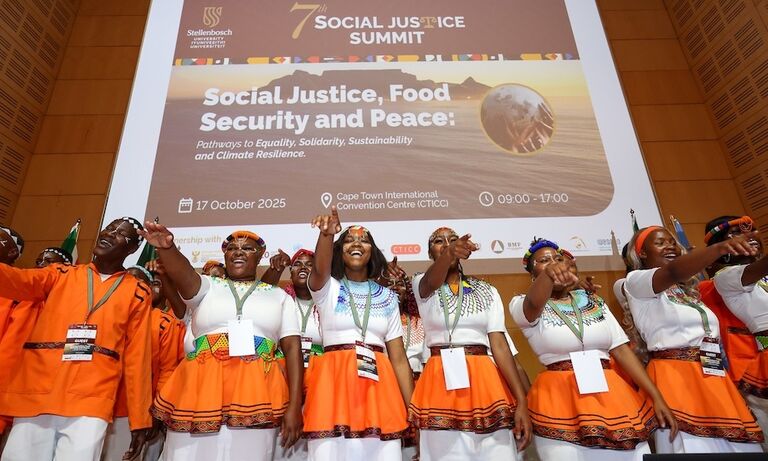
These themes resonated strongly during the recent African Civil Society Dialogue on the G20, hosted by the AU’s ECOSOCC under the banner “Solidarity in Action.” Participants – grounded in lived experience – moved beyond highlighting problems to offering tangible, solution-focused strategies around solidarity, equality, and sustainability.
Far from just “problem talk,” participants – having experienced the challenges first-hand, shared real, actionable solutions. I left inspired by the youth-led energy and unwavering belief that Africa’s vast, young population is its secret weapon.
Africa is big. It is the second-largest continent in the world, accounting for about 20% of Earth’s total land area with an estimated population of over 1.4 billion people, or about 16% of the global population. Africa is also a young population. Children under age 15 account for 41% of the population in 2017, and young persons aged 15 to 24 account for an additional 19% representing 60% of Africa’s population, making Africa the world’s youngest population.
This is our power. We must come together and stand in solidarity with one another. We need to harness the power of our young population to lead change. Recent protests led by Gen Z across the globe have brought longstanding social and political tensions into sharp focus. From Nepal to Madagascar, young activists have organised mass demonstrations driven by youth dissatisfaction with inequality, governance, and social conditions, including health, education and rising costs.
Young people, through social media and innovative forms of protest, have drawn international attention to their causes, influenced public opinion, and, at times, even swayed policy decisions. These movements exemplify the powerful shifts that can occur when a new generation becomes motivated, mobilised, and determined to create lasting change in society.
But, with just over a week to go before the Leaders’ Summit, President Trump announced recently that the US will not be coming, citing the false narrative that the ruling government discriminates against whites. The actual reason, however, is their complete rejection of South Africa’s themes of equality, solidarity and sustainability. Without the involvement of such a key global economic player, many experts believe the summit’s ability to facilitate meaningful discussions and agreements on topics like international economic cooperation, managing debt crises in developing nations, and establishing coordinated policy responses may be significantly diminished.
I disagree. While the USA is powerful, it is no longer the moral compass people once believed.
This is our opportunity as Africans to stand up and say no to global inequality and ecocide. The well-being of people and the planet must be central to the global economic agenda, requiring inclusive investment in infrastructure, health, education, and energy while rejecting extractive models that deepen inequalities.
Africa has both the reasons and the roadmap to lead global progress. Let’s harness our collective voices and shape a brighter, more inclusive future for everyone.
Now, more than ever, unity, equality, and sustainability must guide us.
#PushForward4Equality
Comments
Related news