Malawi: Women’s cooperatives register strides in agribusiness

With a watering can in her hand, Desi Manyamba, chairperson of Nyambwe Cooperative, walks into the cooperative’s greenhouse to water seedlings prepared for tomato and vegetable production. This has recently become a routine for Manyamba and the other 30 members as the group—formed in 2019—plans to expand into high-value horticulture.
The cooperative, based in Mkumbira Village in the area of Traditional Authority Mkagula in Zomba District, is transforming the economic fortunes of its members through greenhouse vegetable production.
The grouping, which started as a club in 2009 with 10 members, later grew to 15 in 2014 when it transitioned into an association before finally becoming a cooperative with support from COMSIP Cooperative Union Limited.
Apart from greenhouse farming, the cooperative grows various crops, including maize, groundnuts, pigeon peas and sweet potatoes on a two-acre piece of land.
Manyamba says that since 2023, the cooperative has been supplying produce to primary schools in the area under the Home-Grown School Feeding Programme implemented by the World Food Programme in collaboration with the Ministry of Education, with support from the European Union (EU).
“We supply rice, maize, groundnuts, pigeon peas, beans, tomatoes and onions to schools,” she says. She adds that members have achieved financial independence as they are now able to provide food for their families.
The cooperative later acquired land where it constructed pigpens capable of holding dozens of pigs, contributing to income generation among members.
“Currently, we have seven pigs and goats,” Manyamba says.
She adds that the cooperative’s long-term plans include constructing a warehouse and purchasing a mill and dairy cows.
However, she notes that the group continues to face challenges accessing markets for sweet potatoes.
Gift Mbwana Makumu, a Nyambwe Cooperative member who joined in 2016, says she has gained extensive knowledge in farming and business management through the grouping. She grows crops on her half-acre field, which she also supplies to primary schools.
The cooperative’s treasurer, Susan Magalasi Muleya, says she has benefited greatly from her membership.
“I bought goats and also improved my house by buying cement, burglar bars and iron sheets,” she says.
Her colleague, Zione Phwetete, says that through the cooperative she has built a modern three-bedroom house and managed to pay school fees for her child who is in secondary school.
The story of Nyambwe Cooperative is not unique. Amayi Titukulane Cooperative from Group Village Head Sulumba in the area of Traditional Authority Chikowi is another all-women group registering notable success in pig farming.
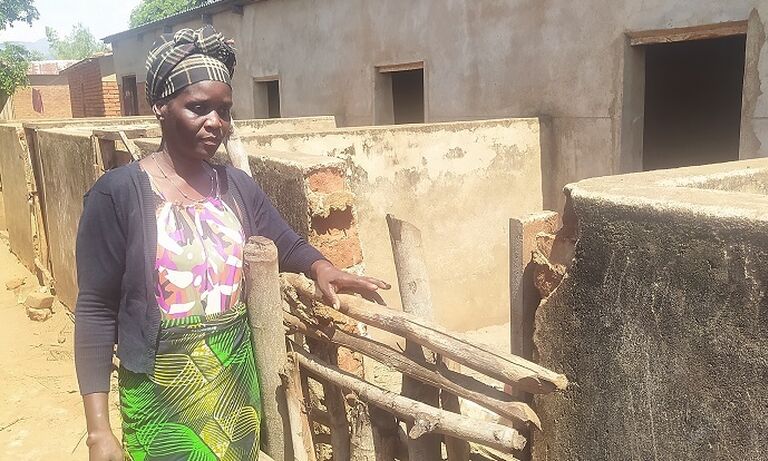
Formed in 2020 and boasting 45 members, the cooperative’s hard work was rewarded when the Agriculture Commercialisation (AGCOM) project awarded it a matching grant of K71 million, which was used to construct pigpens for members.
“We used the funds to build pigpens for each of the 40 members at the time,” says chairperson Grace Komwa. The group also bought 90 piglets—10 males and 80 females.
“I received three piglets, and one of them gave birth to five. I sold some after they matured,” Komwa explains.
She says she uses proceeds from the sales to pay school fees for her two secondary school-going children, amounting to K114,000 per term.
One of the pig kraals which was constructed using AGCOM matching grant
The association currently sells piglets to a Mchinji-based businessperson at competitive prices.
Komwa adds that they have applied to transform the grouping into a fully-fledged cooperative with a membership of up to 100 through a piglet pass-on initiative.
She notes that although the cooperative initially struggled to administer vaccines and meet deworming requirements for pigs, the situation has improved following technical support from an agricultural extension worker.
Another member, Joyce Muhoko, says pig farming has transformed her life.
“We are benefiting a lot. I have bought a plot of land through this and intend to build a house,” she says.
Authorities commend progress
AGCOM National Coordinator Dr. Ted Nankhumwa has applauded the women’s cooperatives for their hard work, describing their efforts as success stories worth commending.
Zomba District Trade Officer, Andrew Chingwandu, says the office trains farmers in value addition to ensure they realise reasonable profits from their agribusiness ventures.
“Our office also trains cooperatives in marketing, business and financial management,” he says.
Commenting on the challenges of market access, Chingwandu says once the two cooperatives start producing in larger volumes, the trade office will link them to reliable markets to enhance their profits.
He adds that through government and international support, the office raises community awareness on crops that offer value-addition potential.
Chingwandu further notes that the Ministry of Trade, through the district trade office, works with the Malawi Bureau of Standards to help cooperatives improve the quality of their products in line with set standards.
Associate Professor of Food Science at the University of Malawi, Victoria Ndolo, encourages farmers to embrace value addition.
“There are many crops grown in Zomba, such as orange-fleshed sweet potatoes, which can be transformed into flour,” she says. “The flour can be used to produce cakes, bread, doughnuts and other snacks.”
However, Ndolo stresses that the women need more support to make value addition a reality.
Recently, MCCCI chief executive officer Daisy Kambalame emphasised the importance of supporting cooperatives to spur economic development.
“Farmers can only flourish if the country commits to creating a market for their products,” she said. “We need to ensure that wealth circulates within our communities, creating jobs and lifting families out of poverty.”
During the launch of the inaugural Malawi Trade Report 2025 earlier this month, Minister of Trade Dr. George Partridge highlighted the importance of enhancing value addition to boost exports and minimise the country’s trade deficit.
“The report reveals a trade deficit of $2.36 billion, with exports contracting to $758.5 million while imports remain elevated at $3.3 billion,” Partridge said.
The National Statistical Office indicates that agriculture remains a key contributor to Malawi’s economy, accounting for about one-third of the gross domestic product and 90 percent of export earnings.
Written by Augustine Muwotcha. This article, first published by YONECO FM, is part of the Media Parity Capacity Building Programme and republished as part of the programme series.
Comments
Related news