Lesotho: Women shatter glass ceiling in carpentry

Carpentry has, for time immemorial, been seen as a man’s world. Heavy tools, construction sites, workshops and benches were associated with masculinity, while women were often encouraged to pursue “softer” more feminine professions - purportedly requiring less physical activity. But who says women cannot be physical, creative, feminine and beautiful?
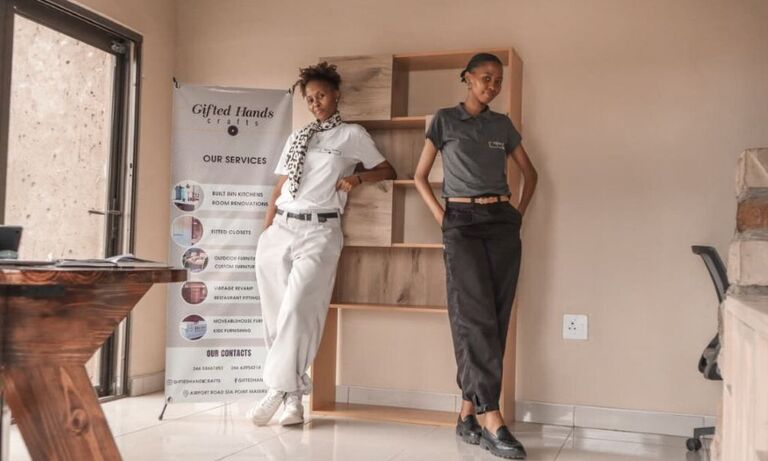
The pretty pair of ‘Mampiti Thamae and ‘Matlotla Morojele (nee Lerato and Thato Tšoeute respectively), are actual living proof that today, women can also be all that and more. The twins, and brains behind Gifted Hands Crafts, are carving their place in the world of carpentry, thus proving that talent, creativity, and hard work are not defined by gender.
At 36 years of age, they stay and are rooted on a road not just less traversed, but one utterly dejected by their kind. They chose carpentry, and Gifted Hands Crafts is their tool.
“Carpentry, a field often seen as the domain of men, became our canvas. We chose it not because it was easy, but because it challenged us to prove that creativity, precision, and vision know no gender” grins Thamae in reminiscence.
For the duo, carpentry was never just about wood and tools. It was about possibility. They believe that their journey was driven by passion- the desire to design, create, and leave behind work that carries meaning. Every one of their creations tells a story of determination and belief. Through Gifted Hands Crafts, the sisters have built a brand that stands for artistry, sustainability, and women’s empowerment.
Although they have earned a place at the pioneers’ table of women who have chosen to defy the odds and stereotypes of engendering roles, they admit that their road was not (and still isn’t) smooth sailing. They have had to swim against the tide in proving that even as women, they are nearly as capable (if not more) and as creative as their male counterparts in this male-dominated field.
Like many women in male-dominated trades, the sisters faced serious challenges when they started. Social attitudes were among the biggest barriers. Many people doubted their abilities, questioned their presence in workshops, or assumed they were less capable than men.
“We faced stereotypes, doubts, and constant questions about whether we really belonged in this space. But we learned that the best way to silence doubt is through excellence. Each project became our voice, and each finished piece became our proof” says Morojele proudly.
Over time, their quality work spoke for itself. Slowly, skepticism turned into respect. Today, their business is changing how people view women in carpentry- not as helpers or exceptions, but as leaders.
“Through Gifted Hands Crafts, we’ve seen perceptions shift, people no longer ask if women can do carpentry. The proof, as they say, is in the pudding, and in our case, in the wooden masterpieces” Morojele adds with a chuckle.
While talent and determination are essential, strong support systems play a major role in turning skills into sustainable businesses. It would seem, for the twins, luck smiled in their direction as they enjoyed very strong support structures right from their spouses, who did not just urge them on and believe in them, but went on to also provide the very necessary financial support.
“Whenever we need additional manpower, they are always willing help, and currently they are working with us full-time” Thamae notes proudly.
Then there was the support attained from external facets in the form of training to realize their dream into a resounding success of reality that it has gone on to become.
In 2025, they became part of the Sebabatso Programme, a Government of Lesotho initiative supported by the United Nations Development Programme (UNDP) Lesotho, as well as the third cohort of the Competitiveness and Financial Inclusion (CAFI Cohort 3)-a government initiative meant for youth entrepreneurship development incubated under IGGLE Consulting and Coaching. Through these programmes, they gained practical business skills, financial management knowledge, and mentorship.
“Training and financial literacy have been vital in this journey. The skills offered sharpened our craft, while financial knowledge gave us the courage to manage risks, set clear policies, and grow sustainably. These tools turned passion into a real business,” notes Thamae.
This kind of support reflects UNDP’s broader role in promoting innovation-driven entrepreneurship, especially for youth and women. By providing capacity development training, including financial literacy, UNDP helps informal skills evolve into formal, income-generating enterprises that can grow, employ others, and contribute to the economy.
Qethekile Lefoka, founder of Que Technical Institute, one of the growing technical and vocational institutions in the country offering training to scores of mostly young people each year, commends the bravery of women who forego so-called ‘girly’ professions, for such ‘manly’ fields as carpentry and not just survive but actually succeed.
“Many women believe carpentry is only for men because it involves physical work and has always been seen as men’s work,” Lefoka notes, adding however that, in later years, attitudes have been on a constant change.
“In the past, very few women entered this field, but attitudes are changing. Today, many women are running their own workshops and proving themselves on job sites. Proper training helps people take women carpenters seriously,” he says noting that they currently have seven women enrolled in the carpentry programme with three already graduated.
Lefoka encourages women to set and pursue career dreams in any field, as there are no more so-called men jobs, and moreover, to think beyond employment and toward entrepreneurship.
“With the right skills and business knowledge, women can grow their enterprises to the point where they employ others,” he says.
Beyond training institutions, organizations like RISE International are helping women turn technical skills into strong businesses. Reitumetse Nzeku, Country Director for RISE International in Lesotho, says their work focuses on supporting women and youth in the built environment sector.
“We offer business incubation, skills development, and enterprise support, which include costing, financial management, compliance, marketing, and contract management- skills often missing in technical training” she says.
RISE International also provides gender-responsive entrepreneurship training, mentorship, and market access, helping women overcome exclusion and bias in male-dominated industries.
“The impact has been clear, we’ve seen more women formalise their businesses, secure better contracts, and gain recognition as professionals. Many go on to employ and mentor others,” Nzeku explains.
The twins believe that young women have all it takes to be whatever they can set their minds up to.
“Do not let tradition define your limits. Equip yourself with skills, embrace learning, and stand proudly in your craft.”
Carpentry is no longer only about wood and tools. It is about shaping stories, shaping homes, and shaping a more inclusive economy- one where women are not on the margins, but at the center, building a future with confidence and skill.
Written by Phongwazana Sakachane. This article, first published by Informative News, is part of the Media Parity Capacity Building Programme and republished as part of the programme series.
Comments
Related news