G20: Women’s and LGBTQI rights under threat

Women’s and LGBTQI rights are facing mounting threats in the lead up to the G20 Leaders’ Summit 22-23 November 2025, less than a week away. The Summit brings together global leaders from 19 of the world’s most powerful economies (18 now with USA pulling out) and two regional blocs – the European Union and African Union – to discuss international economic cooperation and policy coordination, aspiring to foster global financial stability and growth.
South Africa is the G20’s only African member, and this year marks the first time the Summit convenes on African soil. This historic moment is a monumental opportunity to spotlight African priorities and leadership in addressing urgent global economic, social and political issues. Guided by the themes of Equality, Solidarity, and Sustainability, South Africa’s year-long presidency has advanced a progressive agenda focused on the issues most affecting the continent – and the world.
Women, LGBTQI people and other marginalised groups bear the greatest burden of limited financial access, poverty and the climate crisis; their lived realities have been intentionally centred in G20 engagement and working group conversations. However, despite this progress, the USA – along with a handful of allies and conservative delegations – has opposed even basic language that signals inclusion and equality, rejecting terms such as gender and intersectionality due to their opposition to the fundamental rights of LGBTQI people. The USA is boycotting the Leaders’ Summit in its entirety.
Progress, rights, and equality are under greater threat than ever
Collectively, G20 members account for around 85% of global GDP, over 75% of international trade, and about two-thirds of the world’s population. While the forum began with a focus on macroeconomic issues, its agenda now spans trade, climate change, sustainable development, health, agriculture, energy, the environment, and anti-corruption. The year-long process involves hundreds of multilateral meetings to negotiate policy positions and draft communiqués for the Leaders’ Summit.
This work unfolds across three main tracks: the Sherpa Track, which covers socio-economic priorities—including agriculture, health, climate, and women’s empowerment—through roughly 15 working groups; the Finance Track, led by finance ministers and central bank governors, which addresses economic and monetary issues through eight technical groups; and 14 official engagement groups, which bring civil society and expert perspectives into G20 decision-making.
The W20 (Women) and C20 (Civil Society) Engagement Groups have spent the year consulting widely to develop submissions to G20 leaders. The W20 – bringing together business, academia and civil society – issued a communiqué calling on leaders to collectively tackle global poverty, underdevelopment and gender inequality by securing consistent financing for equality, improving gender data, and strengthening accountability for gender mainstreaming.
The W20 also set new 2035 minimum targets—the Johannesburg Goals—to reduce the female labour force participation gap, gender wage gap and unpaid care gap by 35%. Urgent action is also recommended to eradicate modern slavery and promote inclusive economic growth by expanding women’s entrepreneurship, financial access, market participation and redistributing unpaid care work.
Likewise, the C20 – bringing together stakeholders across the civil society spectrum – developed a policy pack calling for urgent, systemic reform of global financial, economic, and governance systems to address persistent inequality, with a strong emphasis on empowering the Global South. Key proposals include democratising institutions such as the IMF and World Bank, securing debt relief, advancing fair trade rules and redistributive measures, and prioritising investments in gender equality, resilient food systems, and universal labour and social protections, particularly in the informal and care economies. An equitable climate transition, decolonised knowledge systems, and stronger civic participation are highlighted as essential to building inclusive, resilient societies and advancing global justice.
These recommendations are grounded in data, statistics, and lived experiences of those most silenced in communities. They are evidence-based policy interventions that serve the majority of the poor and dispossessed—but not the minority who benefit from exploitation and extractivism. These are legitimate demands for a world in 2025, marked by wars, rising inequality, genocide, and ecocide.
The geopolitics involved is complex and largely hidden from public view – another barrier to human development, as superpowers like the USA play with the lives and livelihoods of billions. We will never truly know what happens behind the scenes at these forums, nor can we be certain what will emerge from the Leaders’ Summit. Will all the effort have been worthwhile? In my experience, geopolitics often prevails over real progress. We end up with beautiful outcome documents – but what happens to them afterwards? Does anyone ever look at them again?
So often, though, it’s more about what we do as citizens who care, that makes the difference – it may sound trite, but we really are the people. In fact, we are about 1,5 billion Africans. We have the power. Why do we refuse to use it? We are who we’ve been waiting for. The time is now for Africa to rise and lead in the spirit of Ubuntu. We have the human and natural resources to stand up to global powers who are trying to erode the international human rights and economic justice system.
We, as South African women and men in all our diversity, refuse to stand silently and watch as decades of progress and hard-won rights enshrining human rights for all are eroded. Feminist and women’s groups are organising a #TotalShutdown in South Africa to demonstrate the devastating impact of gender-based violence alongside the vital role women play in sustaining the economy.
It is calling on all women and members of the LGBTQI+ community across South Africa to refrain from all paid and unpaid work in workplaces, universities, and homes, and to spend no money for the entire day to demonstrate the economic and social impact of their absence. The message is that “Until South Africa stops burying a woman every 2.5 hours, the G20 cannot speak of growth and progress.”
Even if we have no power as citizens to influence the outcomes of the process, we can stand together under the banner of equality, solidarity and sustainability. On Friday, 21 November, consider wearing black and stopping for 15 minutes at noon to stand in mourning, memory, and resistance with women survivors and carers not only in South Africa but across the globe.
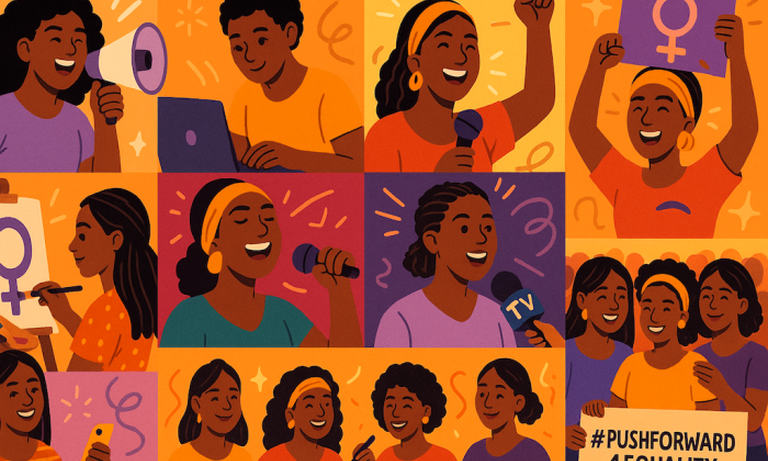
#PushForward4Equality
Comments
Related news