Marang: Intersex Genital Mutilation: From visibility to protection

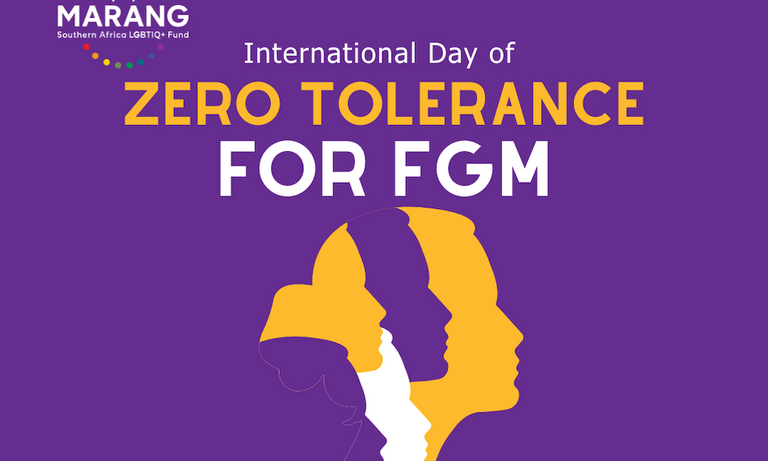
A Marang Fund Webinar Commemorating the International Day of Zero Tolerance for FGM
On the International Day of Zero Tolerance for Female Genital Mutilation, the Marang Fund convened an intersex-led regional webinar that refused to sit comfortably in abstraction. This was not a symbolic conversation. It was not academic. It was not polite. It was a reckoning.
Building on last year’s Intersex Awareness Day dialogue, this year’s focus moved decisively from visibility to protection. Because visibility, as our panel reminded us, has never guaranteed safety.
Naming the Harm
From the outset, the conversation made clear that Intersex Genital Mutilation (IGM) is not a metaphor. It is not a “complex medical issue.” It is not a misunderstanding. It is harm.
Opening the session, Lusanda Mamba grounded us in a simple but uncompromising truth; bodily autonomy, informed consent and dignity are non-negotiable human rights. She reminded participants that marginalising intersex issues within broader LGBTIQ+, gender justice and health justice spaces creates fertile ground for violence to continue unchecked. Silence protects perpetrators. Margins enable harm.
The space was intentionally held with care. Community agreements invited respect, confidentiality, and the freedom to step away if the weight became too heavy. And heavy it was. Because when the panelists spoke, they did not offer theory. They offered memory. “They said they were fixing the child.”
Moderator Zsa-Zsa Fisher posed a piercing question, “Why is visibility not enough?” Chola Mumba answered with a story that silenced the room. He described an intersex child in Zambia whose genitals were cut open by medical professionals, in front of their mother, using a razor blade. The justification: they were “fixing” the child. There was no consent. No urgency. No emergency. Only a belief that difference must be corrected. Visibility, Chola argued, can make intersex bodies more vulnerable when it is not paired with protection. “People know we exist,” he said, “but that can invite more violence, more attempts to ‘correct’ us.”
The language used in official medical documents, “abnormal,” “handicapped,” “disorder”, becomes permission. Words pave the way for blades. Peace Maquba built on this, pointing to the deep contradiction within African legal systems; torture is prohibited, yet IGM continues largely unchallenged. Policies exist, but they do not serve intersex people. Accountability mechanisms are weak. Medical authority often goes unquestioned. “Without protection,” Peace said quietly, “visibility increases vulnerability.” From Uganda, Gloria Kanyesigye described a climate of fear where intersex people remain hidden “behind curtains,” forced to prove their bodies before their humanity is believed. In contexts shaped by hostile legislation and social stigma, existence itself becomes dangerous.
The Personal Cost
When asked to define IGM in accessible terms, the responses cut deeper than any legal analysis could. Peace described IGM as systemic control rooted in patriarchy and heteronormativity. As a child, they were told surgery was necessary to make them “sexually appealing.” That sentence alone revealed the violence embedded in medical thinking: a child’s body altered for imagined future desirability. “It is unnecessary. It is harmful. And it disconnects us from our own bodies.” Gloria reminded us of the irreversible nature of these interventions. Once surgery is performed on a child, there is no undoing it. No return to the body as it was. No rewinding consent.
Chola named the aftermath that is rarely documented in official files:
- Loss of sexual sensation
- Chronic pain
- Psychological trauma
- Isolation
- In some cases, suicide
“There is no follow-up,” he said. “No counselling. No hormone support. Children are left to deal with pain and confusion alone.” This is the part often missing from policy debates. The long nights. The unanswered questions. The quiet grief of realising something was taken from you before you had the language to understand it.
Consent: Who Holds the Power?
The discussion on consent revealed a stark hierarchy.
Parents.
Doctors.
Community leaders.
Policymakers.
And intersex people themselves, last in line. “We watch everyone make decisions for us,” Gloria reflected. In some communities, elders or chiefs decide the fate of an intersex child. In extreme cases, infanticide is sanctioned. These are not distant historical practices. They are contemporary realities. Peace called us back to empathy: intersex is a natural human variation. It can occur in any family. The issue is not abnormality. The issue is control. Meaningful consent, the panel stressed, must come from the individual, at an age where they can understand their body and choose for themselves. Anything less is coercion dressed up as care.
Resolution 552: Tool or Threat?
The African Union’s Resolution 552 emerged as both a possibility and a limitation. Chola described it as a double-edged sword: imperfect in language, yet a critical African-led advocacy instrument that can open doors for reform. Peace cautioned that the resolution often reflects binary assumptions and fails to capture the complexity of intersex variations. Gloria emphasised that protection cannot exist on paper alone. Community-level education is essential. Legal protections must be understood from the ground up, not only drafted at continental summits. Because laws do not protect people who do not know they exist.
Holding the Courage
As the webinar unfolded, what became undeniable was the emotional labour carried by the panelists. They did not owe us their stories. They did not have to revisit trauma. They did not have to educate us through their own pain. And yet they did. Their bravery was not loud. It was steady. It was measured. It was generous.
Lusanda closed the session by acknowledging that labour directly, “We hold space with you. Your courage shifts the needle. This is human work, and it requires us to show up with humanity.” That was not rhetoric. It was recognition. Because courage, in this context, looks like speaking about surgeries that were never consented to. It looks like naming harm in systems that still wield power. It looks like demanding protection in environments that would rather debate terminology.
From Visibility to Protection
The central message of the session echoed clearly: Intersex bodies are not problems to be solved. Zero tolerance must include protection; in hospitals, in homes, in cultural spaces, in policy frameworks.
Protection means bringing intersex people to the table.
Protection means co-developing medical protocols.
Protection means intersex-specific funding that allows organisations to lead their own work.
Protection means reforming psychiatric, medical and legal systems so that intersex bodies are no longer treated as anomalies or experiments.
“Nothing about us, without us” is not a slogan. It is a survival principle. The baton is in our hands. Visibility was never the end goal. Protection is.
The Marang Fund will continue to deepen this regional dialogue, to strengthen intersex-led advocacy, and to insist that bodily autonomy is not negotiable. But the work does not sit with intersex advocates alone. The baton now rests with all of us; funders, policymakers, medical practitioners, movement leaders, and families.
We were asked to listen. We did. Now we must act.
Comments
Related news