Reclaiming power and redefining feminist governance

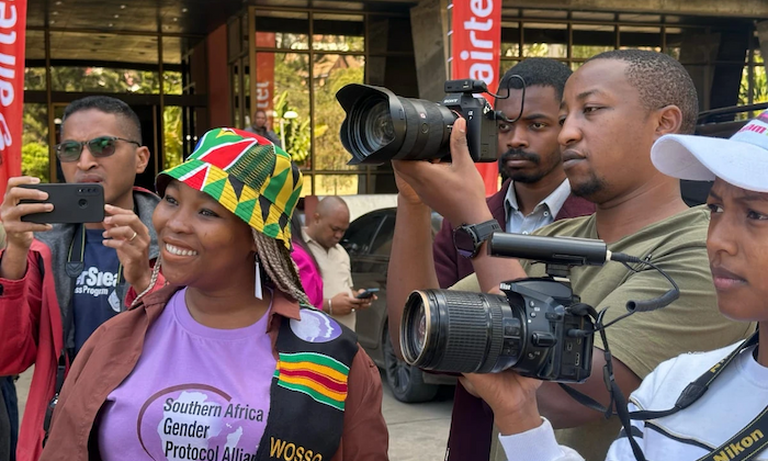
Zintle Khobeni's journey into leadership did not begin in boardrooms or policy spaces. It began in Ndofela Village in South Africa's Eastern Cape, where gender-based violence is a lived reality and justice often feels distant. As a survivor of gender-based violence, she refused to remain a statistic. Instead, she chose to organise, to speak, and ultimately, tobuild systems that respond to the realities of women and girls.
Before joining the Women of the South Speak Out (WOSSO) Fellowship, Khobeni's advocacy focused on working with boys in initiation schools to interrupt cycles of violence. While this work was important, her engagement within c communities revealed a deeper truth, that violence was not only behavioural but rooted in systems of power. Patriarchal structures within traditional leadership continued to exclude women from decision-making, reinforcing inequality at its source.
This realisation marked a turning point. Through the WOSSO Fellowship, Khobeni's advocacy evolved from addressing symptoms to confronting systems. The fellowship strengthened her ability to analyse power, adapt her strategy, and connect grassroots realities to broader governance and policy spaces. It also expanded her confidence to step into leadership, not only as an activist, but as a systems thinker and political actor. Her work shifted towards advancing women's participation in cultural and political decision-making. She began challenging accountability within traditional councils, opening space for women to speak, organise, and demand inclusion in leadership structures that had historically excluded them. These efforts required persistence, particularly in navigating resistance from deeply entrenched patriarchal norms, but they began to shift conversations within communities.
At the same time, Khobeni bridged cultural advocacy with formal political participation. As South Africa approaches local government elections, she is working alongside women in her community to support one woman to run as an independent ward councillor candidate. This represents a significant and tangible shift, moving from advocacy to representation, and from voice to power.
The impact of this work is already visible. Women who were previously silent in traditional spaces are stepping forward with confidence, sharing their experiences and asserting their right to participate in decision-making.
Community dialogues are beginning to challenge long-standing norms, and even within traditional leadership, there are early acknowledgements of the importance of including women. These shifts, while still emerging, signal the beginning of deeper cultural transformation.
For Khobeni, this journey has also been one of profound personal and leadership growth. Through the fellowship, she has strengthened her identity as a feminist leader, gaining the confidence to engage across local, national, and global platforms. From founder of the Great People of South Africa in Khayalitsha, a large township located in the Western Cape province of South Africa, her leadership has expanded beyond community work into regional and continental spaces. She currently serves as a member of the Pan-African Youth Parliament (2026-2027), contributing to discussions on governance, gender, and youth development. She is also part of the leadership of the Southern Africa Youth Forum, where she plays a key role in shaping regional youth agendasand engagement processes. “On a personal level, these advocacy efforts deepened my confidence as a feminist activist and political leader,” she says.