
What the Sunrise Campaign involves
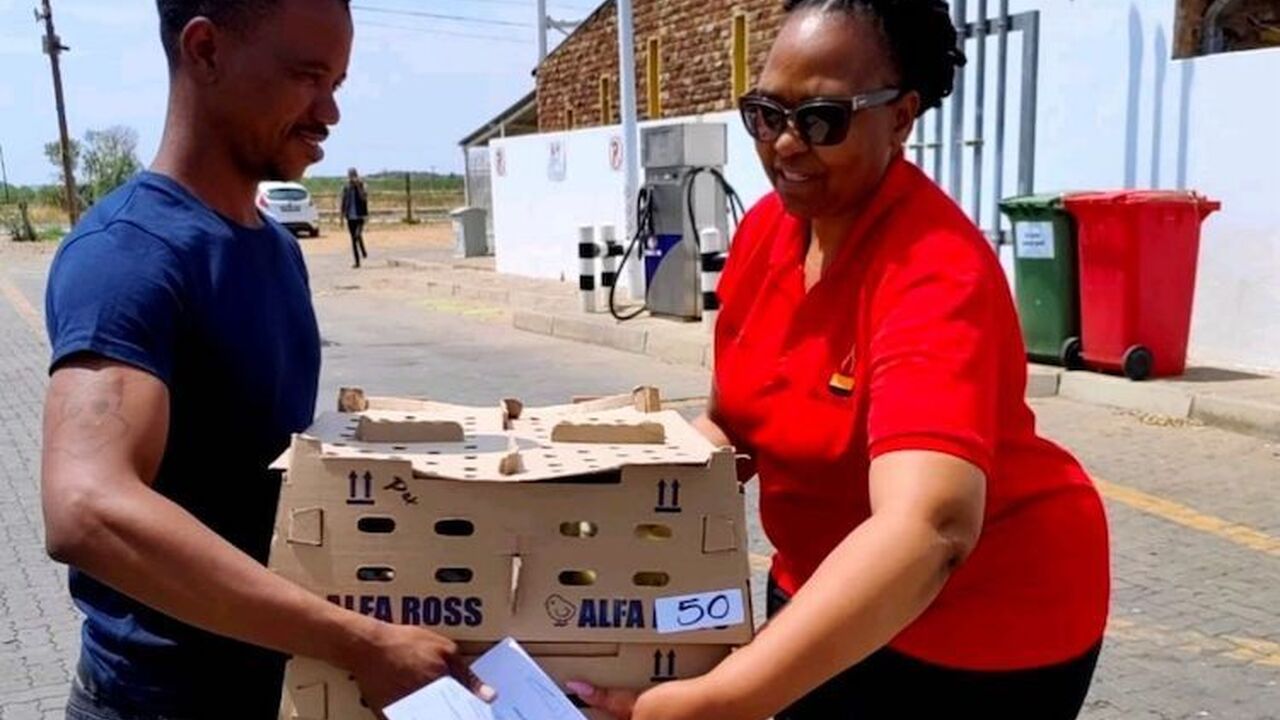
In 2013, Gender Links piloted a programme entitled Empower Women, End Violence to test the hypothesis that increasing women’s agency, confidence and economic power would result in less violence for women in abusive relationships and more control over their lives. Rebranded the Sunrise Campaign in 2016 because of the “new beginning” that this model offered to survivors of GBV, the programme focusses on an integrated approach of Life Skills and Entrepreneurship training including confidence building; decision making, business management, use of IT, networking and addressing the underlying structural inequalities between men and men.
The approach derives from GL’s Theory of Change, which is based on the ecological model.
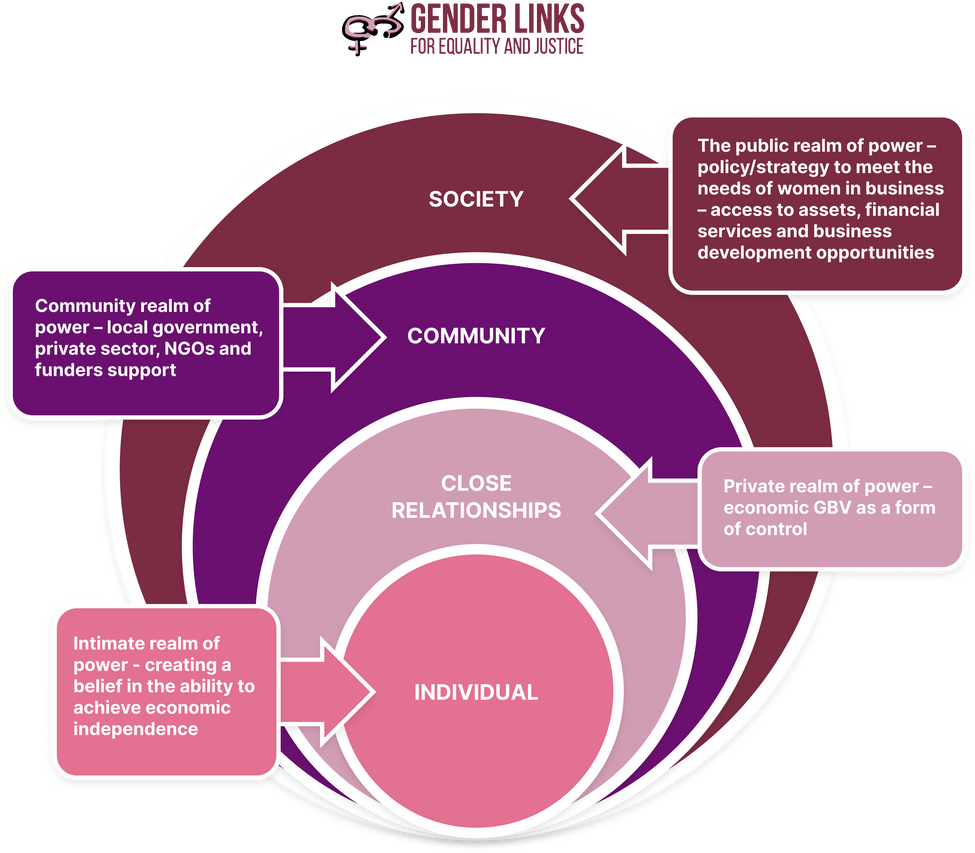
Gender Links Theory of Change

At the individual level, the project links survivors of GBV to Local Economic Development opportunities life and information technology skills training that enhances the agency and reduces GBV for survivors. At the household level, the programme involves at least three family members, including (where appropriate) former perpetrators as part of a parallel rehabilitation programme.
At the community level, the programme forms part of GL’s work on gender responsive governance at the local level through the Centres of Excellence for Gender in Local Government (COEs). Councils commit resources, and run campaigns to end gender violence, and empower women economically, as part of a long term, systemic approach to changing the attitudes that fuel GBV. A unique feature of the programme is that it is anchored by councils that have undergone a ten-stage process to become COEs. The councils include support for survivors of gender violence as part of their GBV and Local Economic Development (LED) action plans. GL provides an entrepreneurship training course tailored for survivors of GBV that combines life skills designed to enhance confidence and agency with basic business skills. While GBV debilitates and destroys self-worth, business builds confidence, negotiation skills, innovation, and resilience. The two forms of training thus complement each other.
| Goal | Survivors of gender violence reclaim their agency and experience a marked reduction in GBV through enhanced economic opportunities and outcomes linked to the economic development plans of local authorities. | |
| Outcomes | GBV survivors with increased agency and economic independence | Economic power is incorporated into local economic development action plans |
| Interventions | Capacity building for GBV survivors on life, enterprise and information technology skills. | Local councils anchor the Sunrise campaign as part of local economic development initiatives. |
| Formation of Women in Local Economic Development (WLED) Networks using appropriate technologies | Review local GBV action plans of host COEs and integrate economic power as a key pillar of the strategy | |
| Problem statement | High levels of GBV in South Africa disproportionately affect every aspect of women and girls’ lives compromising their ability to exercise their rights as citizens; research and anecdotal evidence show that a high proportion of women remain in abusive relationships because of a lack of economic independence. | |
How the Sunrise Campaign has evolved
The model has evolved over three phases to incorporate new learning and become a robust model with a total reach of 13 540: including 3010 GBV survivors trained as entrepreneurs; an average of three family members per household (including where appropriate former perpetrators); Gender Focal Persons; members of GBV and Local Economic Development (LED) committees, the programme has demonstrated the link between economic power and reducing GBV.
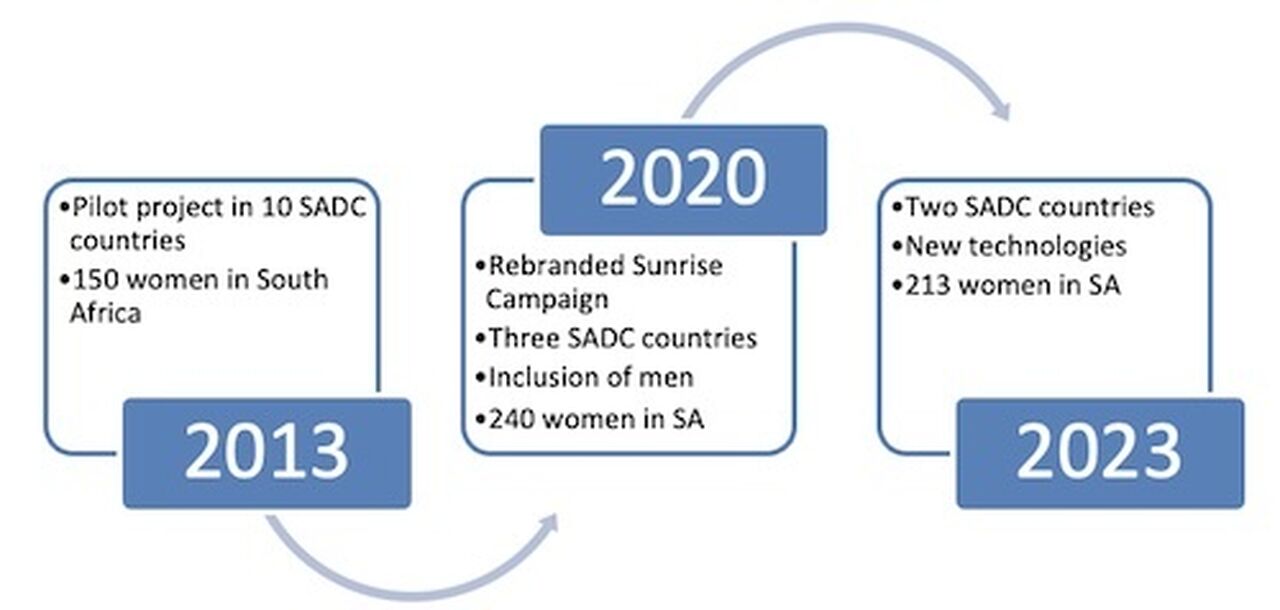
Funding Leadership Opportunities for Women (FLOW) in the Netherlands supported the first phase from 2013 to 2015 in Botswana, Eswatini, Lesotho, Madagascar, Mauritius, Mozambique, Namibia, South Africa, Zambia and Zimbabwe. The United Nations Trust Fund to End Violence Against Women funded the project in South Africa, Madagascar and Eswatini from January 2020 to December 2022. Important innovations included a focus on young women, and the inclusion of men. The project gained momentum in Zimbabwe in 2023 with funding from the Swedish Development Agency (Sida) for Local Economic Development in 12 councils, with the Sunrise Campaign a central pillar. In South Africa, the Irene M. Staehelin (IMS) Foundation based in Switzerland is supporting the project in ten municipalities spread across four provinces.