Lesotho: Widows find solace in faith

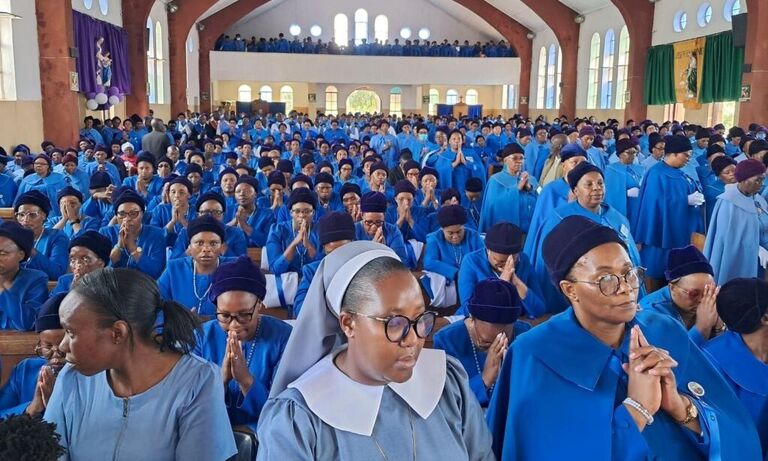
As a country in which the majority of the population are Christians, there are several churches in Lesotho. In these churches, that is where you will find groups of women coming together with one goal which is to serve God and strengthen their faith. In these groups which have different titles depending on each church and the mandate of the group, the majority of widows have sought and found solace.
"Being childless and widowed, also staying alone, there are times when I feel like the world has been unfair to me. When those dark thoughts cloud my mind, the prayers and motivation I get from the Solidarity of St. Anne, quickly take over and I become my normal hopeful self again", this was said by Mrs. 'Malerole Makuta in an interview.
She stated that when she joined the Solidarity within the Roman Catholic Church, her husband was still alive. She stated that she did not only fall in love with the colours of the attire but also liked the fact that members were elderly women, and she felt she could learn a lot from them. She stated that she also felt that they could guide her through her struggle to bear a child.
"In that group I found older women who instilled courage and hope in me. They uplifted me when I wanted to give up on my marriage because I felt like a failure and that it was my fault that me and my husband could not have a child", she said. Mrs. Makuta pointed out that although her husband was not deeply involved in church issues, he was the one who encouraged her to join the association. She indicated that he supported her until the day he died.
She stated that although she still has support from family members and the community around her as a widow, the Solidarity of St. Ann is her number one support system. She said when life gets tough and she becomes lonely, with no one to talk to, she seeks comfort in prayer as per guidance from the Solidarity.
Speaking in an interview President of the Solidarity of the Immaculate Conception in the Archdiocese of Maseru Mrs. Mamoroke Matoko told the agency that there are specific programs targeting widowed members of the Solidarity. She stated that the programs which include retreats characterised by motivations, prayer and counselling always ensures that the women do not feel discriminated against. She said the retreats are conducted in a manner that builds unity, respects each other's boundaries as everyone has a right to privacy adding that observation of human rights is also key and is recognised in the retreats.
She said the retreats for widows are a place of comfort where they can openly discuss their issues and come out looking at life from a fresher and positive perspective so that they are able to meet their obligations. She emphasised that they have to continue to efficiently take care of their families, children and also serve the church.
Mrs. Matoko pointed out that it is common cause that in most cases when a partner dies, the life of the surviving partner changes. She said there are often financial, emotional or spiritual challenges some of which are difficult to deal with especially when one is already struggling to come to terms with the loss.
She indicated that the Solidarity provides psychosocial support. She said those who struggle with the change are always given assurance that the leadership of the Solidarity is there to help.
Mrs. Makatleho Motake, a member of Women's Missionary Society within the African Methodist Episcopal (AME) Church stated that when she joined the society in 2022, already widowed as her husband died in 2014, she felt it was right time. She indicated that when she joined the church in 2013, she took her time to study how the association operated and in 2022 she felt she was ready to become a member.
"Being able to share and discuss life's issues with other women and holding each other's hands through faith was what I was looking for in the society," she remarked.
She pointed out that being a widow is difficult as one has to juggle between all the duties she used to share with the husband and the career. She indicated that being a member of the Women's Missionary Society has kept her occupied and focused. She indicated that through it she has no time to think about the worries of the world.
Mrs. Motake said the various activities offered by the society give one purpose in life. She pointed out that although there are no specific programs targeting widows’ faith and teamwork keep them strong, focused and empowered. She encouraged widows to join associations within their churches.
Founding President of NARISKI Widows and Widowers Association Mrs. 'Mamaboloka Ramakhula stated that widows are believers adding that they are also members of associations in their respective churches. She pointed out that it is faith and prayers that keep them going amidst the challenges that include discrimination and abuse which is mostly characterised by property grabbing.
She indicated that widows are still discriminated against in churches adding that their voices are suppressed in their respective solidarities or church organisations. She said they are expected to serve the church even when circumstance do not allow it. She however said with recent times, the church seems to be taking a different approach towards the widows adding that there are initiatives to better understand and support them.
Mrs. Ramakhula indicated that the NARISKI Widows and Widowers Association always makes it a point that they encourage their members not to seize to pray and participate in church activities. She said those who quit their societies are urged to return.
She pointed out that as life is not only characterised by religion, but the Association is also hard at work to ensure mental, financial, spiritual and physical wellbeing of their members. She said they empower each other through counselling and training on developmental projects especially in agriculture.
Mrs. Ramakhula said there are those who inherited money from their late husband’s therefore it is important to put such money into good use. She added that there are those who are aware of their rights while there are still those who need guidance. She further added that legal fees which are not affordable for the majority of the widows make it difficult for realisation and protection of their rights.
She indicated that in their journey to recovery from loss the association makes time to extend a helping hand to orphaned children with the aim to sooth them and be motherly to them without focusing only on donating to them. She said those who have healed guide others through the journey.
Mrs. Ramakhula said the support from community leaders comprising chiefs and councillors is significant adding that the attitude towards widows is shifting.
While faith plays a significant role in the lives of some widows and they find solace in it, there are those who find comfort in 'Pitiki' a forum where women gather in an enclosed space with the aim to empower each other. The forum which has been in existence from the past is now modernised and is often characterised by motivational talks, traditional songs and dances. This is where women take pride in their Seshoeshoe dresses and Basotho blankets. When one needs to find the latest Seshoeshoe dress patterns and new models of blankets, that is the place to go.
When widows are persecuted, the law is always there to protect them.
The Court of Appeal in Lesotho has during its October 2025 sitting, relying on the provisions of section 10 (1) - (4) of Chieftainship Act 1968 read with the 1974 Amendment, ruled in favour of a widow whose brother-in-law wanted to snatch chieftainship from her.
The widow, Pontso Seoehla Mathealira was married to Seoehla Lechesa Mathealira, the first son of the late Principal Chief of Tsikoane,Peka and Kolebere Chief Lechesa Jonathan Mathealira. Her husband died before he could succeed his father as the first-born son. The father then nominated the widow as his successor and the nomination was endorsed by the local chiefs. It was accordingly recognised and gazetted.
The younger legitimate son, Joel Lechesa Mathealira challenged the succession starting at the Magistrate Court until it got to the Court of Appeal. He argued that as the deceased heir never assumed office, his widow could not lawfully succeed. He added that the chieftaincy ought to pass to him as the rightful successor.
The Court of Appeal held that 'the recognition of the widow was lawful and consonant with precedent, statute, custom, and constitutional protection of the chieftaincy as a cultural institution'.
"Where the heir-apparent predeceases the chief without leaving male issue, section 10(4), read with the 1974 amendment, contemplates a custodial succession by the widow, not an immediate diversion to collateral males. The widow succeeds in her own right to maintain continuity of the senior house until the male line can be restored", said the Court of Appeal in its judgment.
It stated that 'a purposive, constitutional and customary reading of the provision confirms that collateral succession by a younger brother arises only after the widow’s entitlement is exhausted by death or disqualification'. It added that Judicial fidelity to the text precludes importing a requirement that the son must have survived to assume office.
Section 18 of the Constitution of Lesotho caters for the right to freedom from discrimination.
While the rights of widows, especially concerning property and inheritance have been governed by the Customary Law, the Legal Capacity of Married Persons Act 2006 and the Harmonisation of the Rights of Customary Widows with the Legal Capacity of Married Persons Act 2022 changed the landscape.
Widows who were in the past, under the Customary Law, regarded as minors, now have full economic and property rights. They currently have the right to ownership and control of property, administration of the estate, contractual capacity and guardianship of minor children as well as protection against harmful practices.
The legal frameworks targeting women are in line with the (Maputo Protocol) Protocol to the African Charter on Human and People's Rights on the Rights of Women in Africa which aligns itself with the main international human rights instrument for the protection and promotion of the rights of women, the Convention on the Elimination of All Forms of Discrimination against Women (CEDAW).
Written by Makhaba Masekonyela. This article, first published by Lesotho News Agency, is part of the Media Parity Capacity Building Programme and republished as part of the programme series.
Comments
Related news