Cameroon: Beyond conflicts: Picnics of power

By Akem Aurelia Njang
As I write this, we’ve been in lockdown for over five weeks. Maybe it will end in a few days.
But will things truly get better?
We can’t say for sure.
During turbulent times like these, women’s realities are often swallowed up by chaos. Their struggles are brushed aside, their pain normalised, their voices drowned out. Public “formal” gatherings are labelled as propaganda, and in the noise of conflict, the suffering of women becomes invisible.
But should we permit women to keep suffering in silence?
No. Because we have had enough.
Just this year, over 46 femicide cases have been recorded in Cameroon. Is there a monitoring system to ensure that women violated in conflict regions like the Northwest and Southwest are protected?
No.
And so the cases of abuse and gender-based violence continue to climb quietly yet mercilessly. Fear, fed by cultural and social barriers, keeps many women away from “public discussions.” But behind closed doors, they endure violence, trauma, and hardship the world rarely sees.
In the middle of this silence, a simple idea emerged: a meet-and-chat picnic during a ghost town period.
To the authorities, it was just a picnic.
To the culture, something new and harmless.
To the women, it was everything.
A soft rebellion.
A breath of fresh air.
A safe haven.
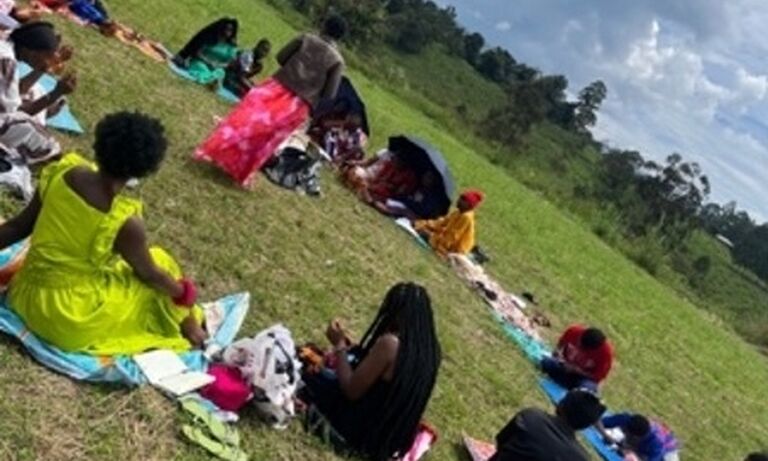
These picnics are not just outings. They are spaces where women and girls who have been stripped of their voices find room to breathe again. Spaces where pain is met with empathy, where hope finds its way back into weary hearts.
During the picnic, a group of girls aged 13 to 18, led by Praises, shared how they’ve been surviving the crisis. They farm for others to earn a living and support themselves. On the surface, it’s economic empowerment. But beyond that, it’s a network of solidarity, a quiet circle where they share adolescent struggles, build strength, and hold one another up.
The picnic was not just a gathering; it became a healing ground.
Young women, single mothers, and young wives sat together, their stories weaving into a fabric of shared pain and shared power.
Joyceline, 26, told her story with tears streaming down her face. Violated as a young girl, now a single mother of two, she struggles to return to school, carrying responsibilities far heavier than her years. Her tears were not just hers; they carried the silent stories of other young girls walking the same dangerous path.
That day, the picnic became what so many spaces fail to be: a space for vulnerability without judgment.
A space where the young learned from the old, and the old from the young.
It may not have had women in their sixties, but it was deeply intergenerational.
A space of solidarity. A space where hands reached out to hold each other up.
Then Nadine, an undergraduate student, asked a question that cut through the air like a blade:
“How do I deal with these struggles when my main challenge is not men but the women and girls I call friends?”
Her voice trembled. Her eyes told a story of betrayal and pain that words couldn’t fully convey. The question evoked emotions in the group. Memories of mockery, judgment, and abandonment surfaced.
Are women truly for women?
Do we support each other the way we claim to?
Even in spaces meant for solidarity, division can creep in. One girls’ group shared how a member who was violated faced not comfort but stigma. She was called names, isolated and blamed. Her pain was weaponised against her. That moment hurt. But it also forced the room to reflect.
This moment reminded us of why the picnic was necessary. A moment not just to have fun but to grow emotionally and intellectually.
On our picnic date, we faced a challenge.
As we moved to our picnic site with permission, of course, a man tried to intimidate us, almost calling the military. But when he realised we were unshaken, he softened. If it had been boys going to play football, the story would have been different.
Ironically, as we packed up to change locations, he said:
“I have girls too… can they join you sometime?”
The same man who tried to intimidate us wanted in. And he wasn’t alone. Many men have asked to join. That in itself is a sign: we are moving forward. Something is shifting.
Lydia shared how a boy asked if she was “losing anything” because of the ghost town.
It’s shocking how many men still think women are not deeply affected by this conflict.
One married woman shared how her husband refuses to support her dream of furthering her education, even though he can afford it. He simply doesn’t want to. Maybe it’s fear. Maybe it’s control. But she’s choosing resilience. Mind you, her current level of education is the same as his. Maybe he just doesn’t want her to be better than him.
Through these picnics, she’s gaining knowledge, confidence, and courage. Together, we encouraged her to pursue her husband’s growth too, because sometimes pushing someone forward opens the door for your own dreams. Still yet, we are proud she’s gaining knowledge and empowering herself in diverse ways.
Despite the challenges, women are finding untold ways to resist, empower, and rise. These picnics are more than social gatherings; they are acts of quiet power.
They are spaces where stories are shared, strategies are built, and pain is transformed into purpose.
We may not carry placards. We may not march through the streets.
But under the trees, on simple picnic mats, we are rewriting what power looks like.
Not loud.
But real.
Not grand.
But unstoppable.
Comments
Related news