Zimbabwe: Gokwe Town Council – Community Education on Climate Change

| Gender Links
Entry 13353
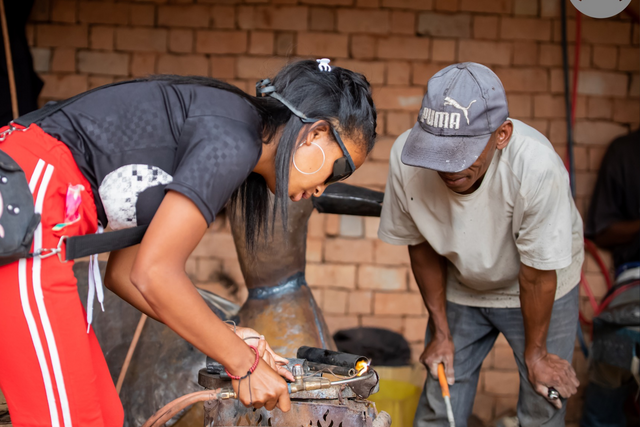
Gokwe Town Council did not have an approved land fill and the Town was practicing crude tipping. The community based health club, Ziso Rehutano, had embarked on a plastic recycling project. That managed to reduce amounts of greenhouse gases that were released into the atmosphere and resulted in ozone depletion and global warming. The recycling project had positively impacted on the reduction of plastic waste streams particularly those from beverages in the town. It was greatly anticipated that in future a facility for energy recovery plant would be installed at the plastic smelting point to facilitate the harvest of liquid fuel (paraffin). According to Institute of Global Environmental Practices (2014), the amount of greenhouse gas emissions from municipal solid waste could be reduced through the 3R's (Reduce, Reuse and Recycle).The project sought to raise awareness to the community about climate change. The emphasis was to educate the community on effects of carelessly disposing waste especially plastic materials and the dangers posed to the environment. In addition to the above, the project emphasizes the need to reduce the quantity of plastic waste. In order to achieve the above objectives, the community had to collect waste materials which included plastic bags and plastic bottles. The collected waste plastic materials would then be put in smelting chambers which would have prescribed temperatures. They would be mixed with relevant amounts of certain types of sand. The type of sand would differ according to the strength of what would be needed to be moulded. After a gauged period of time, the mixture would be placed in water to cool down. The moulded object, for example bricks and pavers, would be removed from the moulder.The project had 11 direct beneficiaries which was made up of 7 women (64%) and 4 men (36%). Indirect beneficiaries were made up of 13 women (59%) and 9 men (41%) making it a total of 22 indirect beneficiaries. There were no online beneficiaries recorded for the project. Direct and indirect women beneficiaries were 20 (61%) and men were 13 (39%). The total number of direct and indirect beneficiaries was 33 people.The project resulted in a high number of voluntary public participation. The community realised the effectiveness of the project and willingly joined to be part of the good cause. The community was capacitated with survival skills which they may be able to use for their own benefit. There was a great change in gender attitudes at individual and community level. The males felt very comfortable working with the females unlike during previous times when some jobs were considered to be meant for males only. Questionnaires were used and the process was conducted in and around the Central Business District (CBD) and residential areas. The questionnaires targeted both men and women.The results showed that people had a great appreciation of gender issues amongst the communities. Performance indicators were also used as a monitoring and evaluation tool. Participatory methods were also used. That method allowed stakeholders to be actively involved in decision making.It generated a sense of ownership of monitoring and evaluation results and recommendations then ultimately build local capacity. A lot of people participated in the activities that were undertaken. The greater participatory populace ironed out some other gender disparity issues that existed within communities. Interviews were randomly held and the active involvement of the gender focal person was very helpful. The total budget allocation for this project was $13 500. There was no gender specific allocation for the project. $3 500 was allocated to gender in mainstream budget projects. The amount given to the project in cash or kind was $10 000.There were a number of challenges witnessed during the implementation and running of the project. The unavailability of an appropriate site to undertake all the activities nearly derailed the project. The town council worked on modalities of leasing an industrial stand to the health club. The council felt that if it donated a stand permanently, some ownership wrangles might arise in future. Another challenge faced was the issue of funds to buy materials. Protective clothing was also a cause for concern. The Environmental Management Agency (EMA) rescued the community by promising to donate protective clothing materials. EMA pledged to disburse the funds for the protective clothing once an appropriate operating site had been allocated but before full time operations began. Technical expertise proved to be another stumbling block but that was overcome by the twinning of Gokwe Town Council with professionals who could offer the necessary skills. Involvement of all stakeholders solved the challenge of funds as a number of well wishers within the town came up offering to fund the project."I'm a proud beneficiary of Ziso Rehutano project which specialises in recycling of waste into paving bricks that are durable. The project has turning out to be a people’s favourite. It has improved our livelihoods and has become a source of income for many of us. We are now able to meet our daily needs, children’s school fees and other basics," jovially said Mary Chifana, who is a Gokwe resident. The 50/50 campaign brought community activation. There had been a rise in community members’ participation in community problem solving processes. Community activation had resulted in motivation of new leaders as witnessed by the leaders of various health clubs who have attended workshops on capacity building. There was an initiation and creation of new community groups. For example, at the start of the 50/50 campaign we had 22 Health clubs and they increased to 26 by the end of 2017. Community competence had improved through information sharing thus improving the understanding of concepts, determinants and theories in health promotion and climate change. That had been done through various interlink programs that had been conducted between the clubs and capacity building conducted between Ziso Rehutano and Chenai Climate Solutions from Karoi.The good practice could be sustained through capacity building workshops where people would always be reminded and further educated about gender issues. That could be done hand in hand with entrepreneurial workshops so as to equip women with survival skills. Gokwe Town council had been giving technical assistance to people who were eager to start their projects. Research and training workshops were of great use to the community as well. During workshops, incorporation of fresh ideas and fostering of partnerships also took place.Comments
Related Stories Of Change