
GL@25: Championing gender equality in and through the media

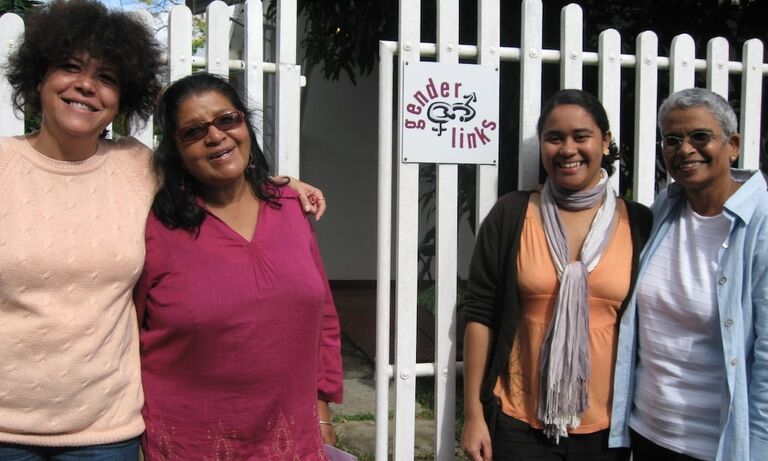
Port Louis, 2 March: The first time I heard of Gender Links, it was through my dearest friend Loga Virahsawmy. I believe it was during the year 2000. We were sitting side by side, listening to a talk organized by the Ministry of Women’s affairs (now Ministry of Gender), and we were quietly complaining about some of the nonsense expressed by one of the speakers.
This was the starting point of our friendship. A few weeks later, Loga phoned and told me about Gender Links, about its founder Colleen Lowe Morna and about the necessity to form a local organization in Mauritius, the Media Watch Organisation.
I had heard the name Colleen Lowe Morna, some years back, after completion of my journalism studies in Paris. On my return to Mauritius and as a practicing journalist, I was invited to attend a workshop in Zimbabwe for journalists of a few African countries, including Mauritius.
The two trainers were going to be Colleen Lowe Morna and Patricia Made from the Women Feature Service. Unfortunately, Colleen could not make it and I was trained by the very professional Patricia Made. We connected immediately. Even though her explanations were pertinent, I realized that gender was not on my radar.
And yet, I had done my studies in France, a country to whom we owe the Human Rights Declaration and the concept of equality. I was covering social and women liberation movement issues for my newspaper l’express.
Living in a multicultural country, I followed the advice of a friend who advised me that when interviewing people, I had to include all the ethnic groups: “balancing my ethnic quota” he used to say.
I believed I was ticking the right boxes until Colleen and Loga did a media monitoring exercise. The result came as a shock and that workshop was an eye opener. Women’s voices were barely heard in the news. I felt I was part of the problem.
This changed my whole perception of journalism and my writing. From then on, and as far as possible, I included women voices in my articles. I negotiated with my editor in chief to do a woman’s profile weekly and he agreed.

With Loga, we went abroad to do training on media monitoring in the francophone countries, Madagascar and the Democratic Republic of Congo, just as we also did training on women in businesses.
And when a satellite office was opened in Mauritius, Colleen gave me the opportunity to work full-time in that office as translator and trainer, with Loga as director of francophone countries. We travelled to Seychelles, Madagascar and DRC to train journalists on different themes. I had never seen myself as a trainer and yet I found myself doing a wide variety of training to fellow professionals from these countries.
I resigned from the Francophone office after one year. Not because I was unhappy but journalism was in my blood and I missed writing articles for my newspaper. And then when Gender Links was starting the training of women in politics, I did not see myself doing that training although I realised how important this was. Having always being impartial in the treatment of news, I did not want politicians to point fingers at me and being told that I was promoting a particular political party.
Although I stopped working full time at GL satellite office, my ties with Gender Links remain strong. Colleen trusts my work as translator and editor. I have translated many documents. The Barometer being the most regular one. With Debi Lee, Publications and Production Associate, Media and Communication at Gender Links, we got on like a house on fire and have been ever since working very well together.
I got the opportunity to go to Bangkok in Thailand with Loga to cover a worldwide conference on HIV and Aids and do editing for a newspaper which was distributed the next day to the participants. I went to Addis Ababa in Ethiopia to do editing of a newspaper on an African Union conference and went three times in New York in the United States to cover the Commission on the Status of Women conferences. All these trips and experiences have opened my eyes more on women’s issues in the world.
I believe that under the drive of Colleen, Loga and Anushka Virahsawmy, there have been positive changes in women’s voices in the media and especially on gender-based violence.
I did workshops with Anushka on a variety of sensitive issues including adolescent sexual health and reproductive rights, violence of the LGBTQIA+ community and the different forms of gender-based violence.
I believe there is a better understanding of these problems in Mauritius although these issues must always be on the forefront.
When Loga stepped down as Board member of Gender Links, I was given the opportunity to replace her. A very difficult task I must say as part of this responsibility as a board member was to look at the finances of the organization. However, it was a great experience to form part of such a high level Board.
As I conclude this piece, there is an image engraved in my mind of Colleen that I will never forget. It is seeing her campaigning for the SADC Gender and Development Protocol and trying to go past security at the Sandton Hotel where the SADC Heads of State were meeting. It was a David against Goliath scene. That multitasking woman is a real force of nature. Today most of the 16 SADC countries have ratified this protocol. It was not an easy fight, but Gender Links has had a major role in winning this battle.
Gender Links has known many ups and downs, has seen wonderful persons getting in and some going out to another world (my special thoughts go to Seana, Sarry and Mme Chigedze and to my fellow colleague Saka Saka, journalist from DRC).
With Gender Links and Colleen, I have broadened my mind, gained knowledge, grown intellectually and I have become a better professional and a better person. We have moved mountains during the past 25 years. My biggest wish for this anniversary is that we get to the top of those mountains!
(Marie-Annick Savripène is a well-known Mauritian editor, translator, interpreter, and Gender Links associate. This article is written in her personal capacity).