16 Days: Lesotho – journey of a thousand stories

Voices from the frontlines of Lesotho’s 2nd GBV survey
Maseru, 8 December: For two weeks in the cool highlands and rugged lowlands of Lesotho, a team of dedicated enumerators travelled to villages, climbed mountains, and sat with strangers in their homes. They were not just collecting data, but they were carrying a space for truth. As part of a landmark and second national study on Gender-Based Violence (GBV), these enumerators became witnesses to the silent epidemic that shapes lives across the country. These are fragments of their journey, pieced together from the echoes of Quthing, Mohale’s Hoek, Thaba-Tseka and Botha-Bothe.
The work began with a quiet, often unspoken, reality. As one supervisor noted, during community engagements, chiefs revealed a painful truth: “victims often hesitated to disclose because of their close relationships with perpetrators, sometimes even family members.” This culture of silence was a formidable first barrier. In Mohale’s Hoek, an enumerator was reminded of its depth by an elderly woman who said, “We don’t talk about these things, but they happen.” That simple admission became a guiding light, a reminder that behind every statistic was a human story waiting for a safe moment to be told.
In Quthing, enumerators confronted the psychological roots of this silence. They learned that perpetrators manipulate victims into questioning their own reality, making them feel responsible. “Victims believe they deserve the abuse,” one reported, noting how cultural beliefs often preach endurance over escape. The emotional toll was visceral. “Some literally cried out loud,” shared an enumerator, who learned to respond with slow, gentle speech, holding space for grief while protecting their own heart.
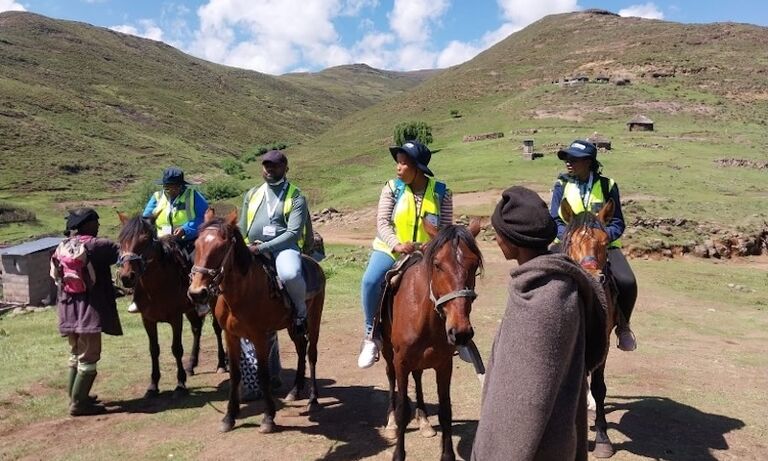
As data collection proceeded, the challenges were as physical as they were emotional. Heavy rainfall made roads impassable, forcing teams to become amateur meteorologists in finding the best routes in the harsh weather. In remote areas, the vehicle would reach its limit, and the final leg was a long, uncertain walk on horseback, on a donkey, or by small boat. “We wasted a lot of time trying to find eligible members,” one team lamented, highlighting the gap between office maps and on-the-ground reality. In Botha-Bothe, enumerators faced aggressive, unleashed dogs at homestead gates, a slight, daily fear not mentioned in any manual during training.
Yet, it was in navigating these uncertainties that the teams’ resilience shone. When a respondent in Quthing was interrupted by her duties, the enumerator adapted, conducting the survey in short pauses between tasks. When household listings were outdated, they worked with local leaders to solve the problem. “Teamwork made it easier,” one noted. “We focused on finding solutions that benefited the team.” This camaraderie was their anchor. On the rainiest days in Botha-Bothe, it was this spirit that drove them to complete their targets, finding solidarity in shared purpose.
Lessons carved from experience
The field became the real classroom. Enumerators discovered that violence in some rural areas is so normalised that it isn’t recognised as such, pointing to a profound need for awareness alongside data collection. They advocated for more training on interviewing people with disabilities and for tools that reflect local realities, like more nuanced questions on alcohol consumption.
Perhaps the most important lesson was about trust. It was not granted automatically, but it was built. “Taking time to greet properly, explain the purpose, and reassure them about confidentiality really made a difference,” shared an enumerator from Mohale’s Hoek. It was about being “children of the community, not strangers,” as another beautifully put it.
When the map is not the territory: lessons from Thaba-Tseka
In the mountain district of Thaba-Tseka, the study’s carefully calculated targets met the uncompromising realities of Lesotho’s highlands. Here, performance was not just about skill, but it was measured against travel time, weather, and the sheer distance between households.
As the Thaba-Tseka team candidly noted, a key challenge was the “widely dispersed villages.” Clusters like Tsoelike and Lesobeng were not just dots on a map but hours apart, often accessible only on horseback.
The team’s resilience was tested daily. A vehicle puncture in heavy rain, miles from town, enumerators falling ill in areas far from clinics, and the frequent absence of men, many away working in South Africa. These were not just obstacles, but they were the context of the data. As the supervisor noted, “Men were largely unavailable,” a simple sentence that speaks to larger patterns of migration and livelihood in rural Lesotho.
Yet, amid these hardships, a powerful success emerged: not a single refusal to participate. In communities where trust is hard-earned, this was a testament to the team’s respectful approach and the community’s growing willingness to engage on these sensitive issues. Despite not meeting its numerical target, the team succeeded in its human objective, to listen and to be heard.
The Thaba-Tseka experience offers a crucial lesson for research in hard-to-reach areas: that logistical planning must account for terrain, not just time. Future studies must align resource allocation with accessibility challenges. Here, the data tells two stories: one of interviews completed, another of journeys taken, obstacles overcome, and a community that opened its doors.
Eyes on the ball
Through it all, a profound sense of purpose prevailed. For every exhausting climb, there was a story that needed to be heard. An enumerator in Botha-Bothe, deeply moved by a survivor of Technology-Facilitated GBV, saw the urgent need for safer digital spaces for girls. They often reminded respondents, “We are doing this study with the hope that its findings will help Lesotho build stronger, more inclusive laws.”
As the teams packed their tablets and left their final clusters, they carried more than data. They had the echo of the older woman’s wisdom, the resilience of survivors, and the conviction that change begins with listening. “Every story collected,” as one enumerator resolved, “is a step toward the justice someone has been waiting for.” This journey of a thousand stories was not just about counting incidents, but about making every voice count.
Kea leboha haholo ho bohle ba arabelang le ba baloang
(Kevin Chiramba and Ntolo Lekau wrote this blog from the consolidated enumerator and supervisors’ fieldwork experiences, as part of GL’s 16 Days of Activism and GBV advocacy 2025.)
Comments
Related news